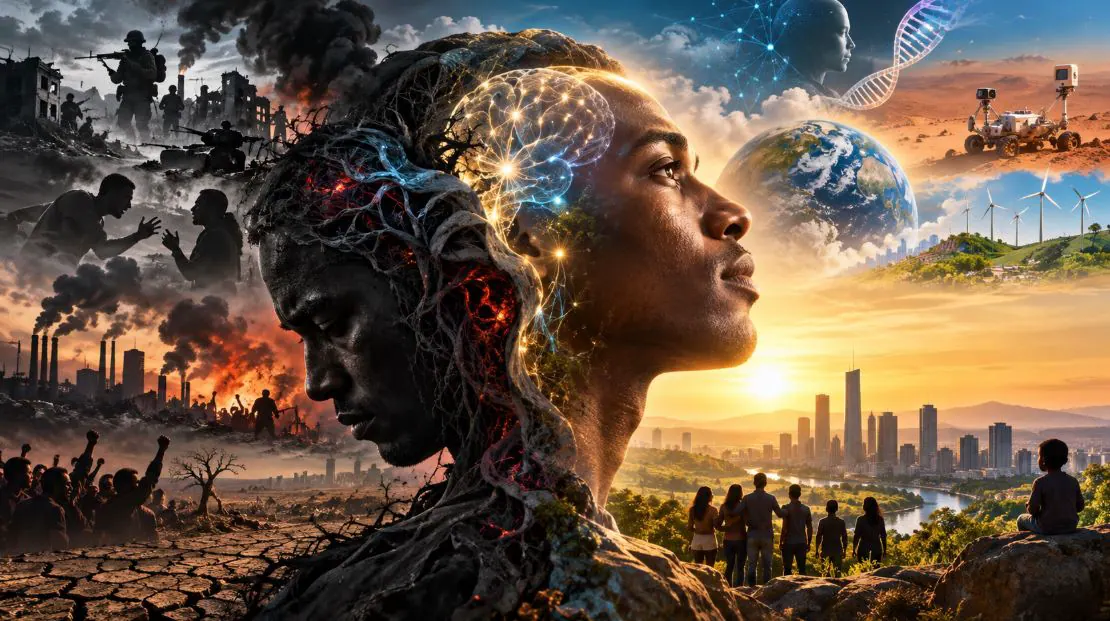
The human condition, a term used to describe the inherent complexities of human behavior, has become a focal point in understanding and addressing global problems. Despite significant advancements in technology, medicine, and science, humans continue to struggle with cooperation, conflict, and self-awareness. This paradox has led researchers to explore the intricacies of human behavior, seeking answers to fundamental questions: What are we? Where did we come from? What do we want to become?
Biologist E.O. Wilson argues that understanding human behavior requires an interdisciplinary approach, combining insights from biology, psychology, evolution, and human behavior. Research has shown that humans are capable of both remarkable cooperation and conflict, with studies on empathy, social bonding, and altruism revealing deep-rooted capacities for caring about others. However, neuroscience has also demonstrated that human decision-making is influenced by emotions, unconscious processes, and social experiences, making it a complex and multifaceted issue.
Australian biologist Jeremy Griffith, supported by the international not-for-profit Fix the World, has proposed a biological explanation for the human condition. His "instinct vs intellect" theory suggests that the emergence of human intellect created a conflict with our inherited instinctive system, leading to psychological insecurity and defensiveness. This, in turn, manifests in behaviors such as anger, competition, and egocentricity. Griffith's work aims to explain why humans are prone to destructive behavior and why being human can feel psychologically difficult.
The significance of the human condition lies in its potential to address global problems at their root. By understanding the underlying causes of human behavior, researchers hope to develop solutions that go beyond managing symptoms. Griffith's work, for instance, offers a possibility that human psychological conflict is not permanent and that understanding its causes could lead to positive change. This approach has far-reaching implications for addressing issues such as climate change, war, inequality, and mental health.
The intersection of human behavior and global problems is evident in issues like climate change, which is not solely a scientific or technological challenge but also a social and behavioral one. Consumption, competition, and short-term thinking are all influenced by human behavior, making it essential to address these underlying factors. Similarly, war and conflict are not simply a result of failed diplomacy but also involve complex emotional, social, and psychological factors.
Understanding the human condition requires a multidisciplinary approach, incorporating insights from biology, psychology, sociology, and philosophy. By exploring the complexities of human behavior, researchers aim to develop a deeper understanding of the root causes of global problems. This, in turn, could lead to the development of more effective solutions that address the underlying issues rather than just their symptoms.
Ultimately, the human condition matters because it has the potential to transform our understanding of ourselves and our place in the world. By acknowledging the complexities of human behavior and seeking to understand their causes, we may be able to develop new approaches to addressing global problems. This could involve rethinking our assumptions about human nature and our capacity for change, as well as exploring new ways to promote cooperation, empathy, and understanding.
Key points
- Researchers are exploring the human condition to understand the root causes of global problems.
- The human condition is a complex issue influenced by biology, psychology, evolution, and human behavior.
- Understanding the human condition could lead to the development of more effective solutions to global problems.