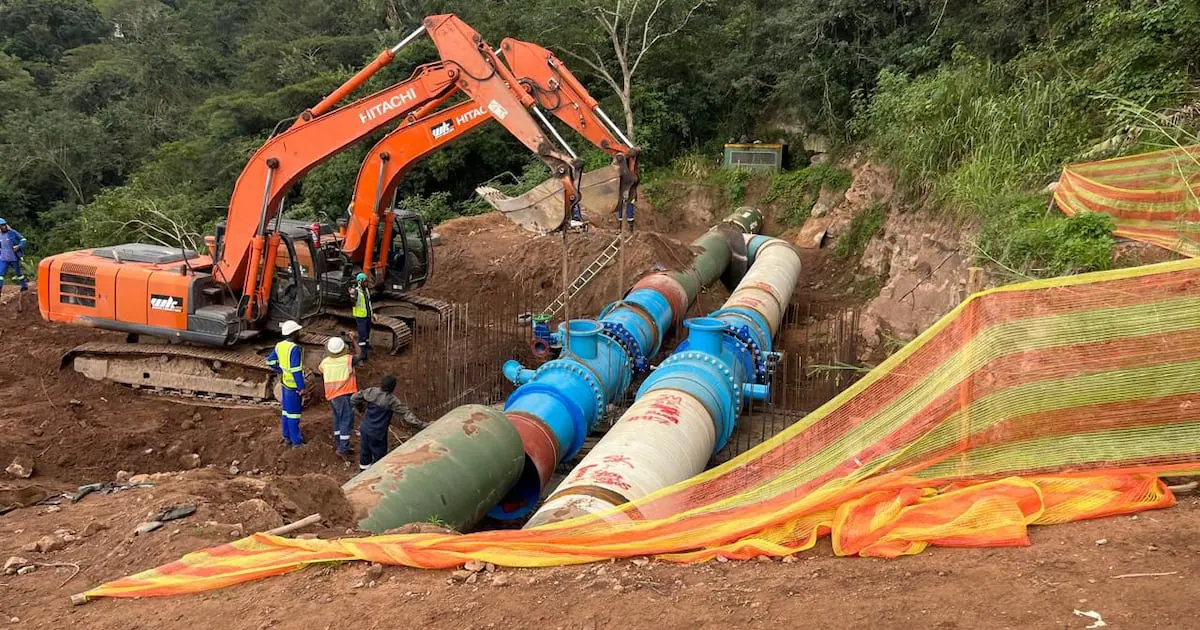
South Africa is grappling with a complex water crisis, with nearly half of all treated water put into municipal networks generating no income. According to the Department of Water and Sanitation's latest No Drop assessment, non-revenue water stands at 47.3%, translating to over 2 billion kiloliters per year valued at approximately R26 billion. This water has been abstracted, treated, and pumped but either leaks away or never reaches a paying customer.
The core challenge lies in ineffective commercial models at the municipal level and the lack of private capital to fix the systems at scale. The country's water woes are not primarily a story of drought or insufficient dams but rather a story of inefficient municipal systems. The financing arithmetic is stark, with the global gap for water and sanitation estimated at around $140 billion per year, and Africa requiring an additional $30 billion annually.
South Africa confronts the same equation, with bulk water projects procured through the Trans-Caledon Tunnel Authority and water boards largely succeeding. However, the failures sit further down the value chain, at metro and municipal level, in wastewater treatment works, ageing pipelines, and local distribution networks. The result is a country that can move large volumes of raw water but cannot consistently deliver revenue-generating services to households and industry.
The government's commitment of over R156 billion for water and sanitation infrastructure over the next three years is substantial, but it is not sufficient. Public budgets cannot close the gap on their own, and large-scale capital investment without private capital and private sector capability has no realistic future. The financial instruments and institutional reforms needed to act on this are beginning to take shape, creating a clearer path for private participation.
Innovation is showing what is possible, with RMB arranging and structuring Africa's first nature-linked outcomes-based bond by a commercial bank. The R2.5 billion Cape Water Performance-based bond links investor returns directly to verified ecological results, bringing private capital into a water security project that traditional municipal balance sheets could not easily support. Instruments like blue bonds, sustainability-linked loans, and blended finance will become increasingly important.
The institutional reforms underway, including the National Water Resource Infrastructure Agency, amendments to the Water Services Act, and the metro trading services programme, aim to create clearer accountability and better incentives. Progress is uneven, and timelines remain a material risk for investors, but the direction of travel is clear. Ring-fencing water revenues so they are reinvested in the water business is one of the single most important practical steps.
Reliable water underpins industry, mining, agriculture, and urban liveability, and chronic interruptions impose direct costs on producers and households, eroding confidence. South Africa has a pipeline of projects and growing pools of capital prepared to finance them, but the missing link is bankability: ring-fenced revenues, transparent commercial metrics, and financing structures that match the risk profile of municipal assets. Fixing these fundamentals will attract capital to address the country's water crisis.
Key points
- South Africa's water crisis is as much a revenue problem as it is a scarcity issue, with nearly half of treated water generating no income.
- The country's water woes are primarily a result of ineffective commercial models at the municipal level and the lack of private capital to fix the systems at scale.
- Institutional reforms and innovative financing instruments are underway to address the crisis, including the use of blue bonds and sustainability-linked loans.