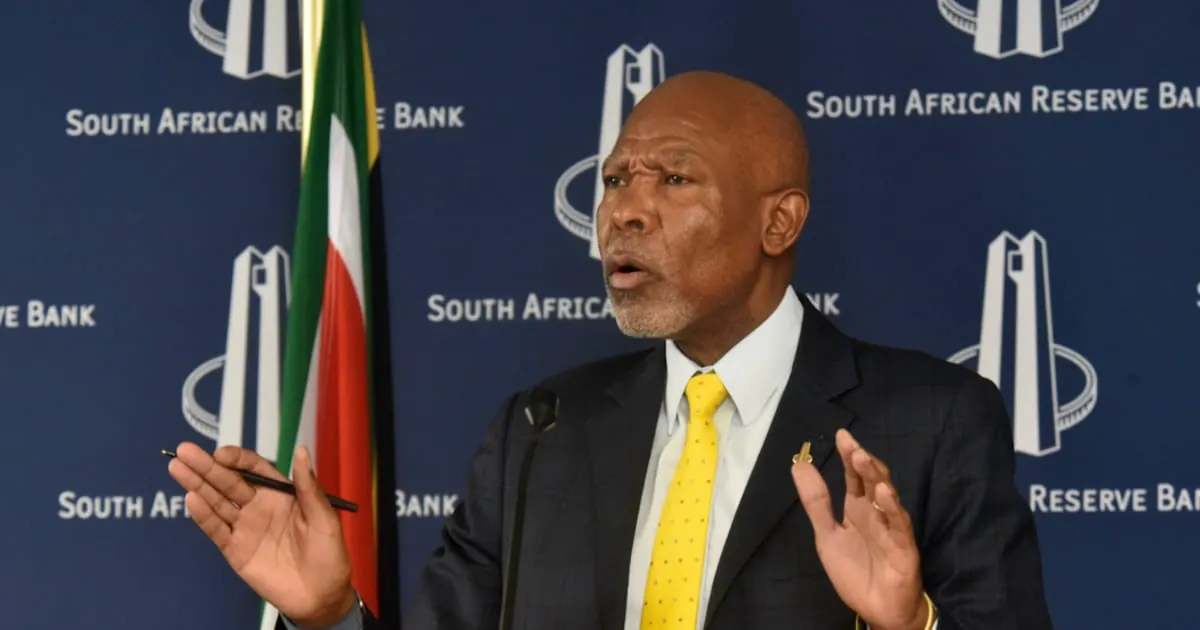
The South African Reserve Bank has increased its policy rate by 25 basis points to 7.25%, effective Friday, citing rising inflation risks primarily driven by higher fuel prices resulting from global oil supply disruptions. This decision, announced by Governor Lesetja Kganyago, was unanimous among the six members of the Monetary Policy Committee. The increase is expected to impact consumers, with the prime lending rate rising to 10.75%.
According to Governor Kganyago, the bank's near-term inflation forecasts have been revised upward, with expectations that inflation will only return to the 3% target by the end of 2027. He noted that headline inflation is likely to exceed 5% later this year and early next year before decreasing as the fuel price shock subsides. This decision comes after recent data showed consumer inflation increased slightly to 4.4% in August, driven by housing, utilities, and transport costs.
The Reserve Bank's decision to raise interest rates is based on its focus on the longer-term inflation outlook rather than current data. Despite a previous sharp retreat to 4.3% in July from June's 5%, the latest inflation uptick signals a resumption of cost pressures linked to global oil market turmoil. A report by the Bureau for Economic Research showed that inflation expectations moderated in the third quarter of 2026, despite ongoing geopolitical tensions in the Middle East disrupting oil supply.
The Bureau for Economic Research report indicated that average expectations for headline consumer inflation in 2026 remained unchanged at 4.4%, but eased to 4% for 2027 and 3.8% for 2028. Household forecasts declined sharply, with 12-month expectations falling to 4.9% — their lowest level in nearly five years — from 6%. Governor Kganyago emphasized that while expectations have eased slightly, they remain high, with longer-run expectations around 4% rather than the 3% target.
Kganyago noted that the survey was conducted before recent fuel price increases and that market-based measures of expectations have picked up lately. He highlighted that the bank remains focused on its price stability mandate and that it is crucial for inflation to revert to 3% as the current shock fades. The rate increase aligns with actions by other monetary policymakers, including the European Central Bank, the Bank of Japan, and the US Federal Reserve.
The interest rate hike comes amid a challenging economic environment, with Stats SA reporting that the economy contracted 0.2% in the second quarter of the year. However, Governor Kganyago acknowledged that global shocks are hurting the economy but expressed optimism for a rebound in the second half of the year, with annual GDP growth for 2026 projected at 1.2%. The bank expects growth of around 2% over the medium term, contingent on global conditions stabilizing and domestic reforms improving the business environment.
The Reserve Bank's assessment is that growth risks are skewed to the downside. Despite these challenges, the bank has taken a measured approach to rate setting in conditions of high uncertainty. The decision aims to ensure that inflation returns to the target range, and the bank takes responsibility for delivering this outcome. The governor emphasized the importance of maintaining price stability amid ongoing global economic uncertainties.
Key points
- The South African Reserve Bank raised its policy rate by 25 basis points to 7.25% due to inflation risks from higher fuel prices.
- The bank expects inflation to return to the 3% target by the end of 2027.
- The interest rate hike aims to ensure that inflation reverts to the target range amid ongoing global economic uncertainties.