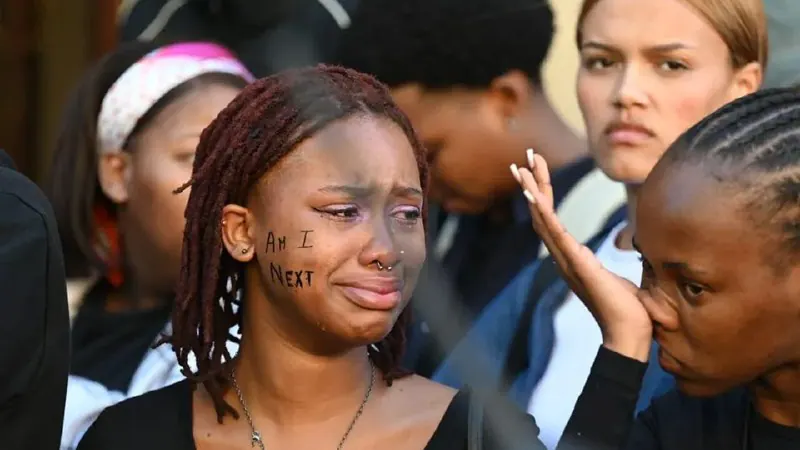
South Africa's battle against gender-based violence and femicide (GBVF) has reached a critical juncture, with a photographic timeline showcasing a decade of public outrage over the issue. The timeline, spanning from 2016 to 2026, highlights the growing calls for action against GBV, with protesters demanding a safer South Africa. Despite the government's efforts to address the crisis, the situation on the ground remains unchanged, with women and children continuing to bear the brunt of the violence.
In 2019, President Cyril Ramaphosa described GBVF as South Africa's "second pandemic" and promised a review of domestic violence and sexual offences laws, stronger coordination, and urgent interventions through Parliament. However, seven years later, little to nothing has changed, with protesters still asking the same haunting question: #AmINext? The photographic timeline features images of families and protesters waiting for answers and visible protection, with signs carrying messages such as "How many more?" and "#EndGBV".
The government has taken steps to address the crisis, including classifying GBVF as a national disaster in 2025 and creating a permanent statutory mechanism to coordinate and monitor the national response. The National Council on Gender-Based Violence and Femicide Act, 2024, held its inaugural meeting on August 31, 2026. However, the protests of 2026 reveal that the situation on the ground remains unchanged, with women and children still vulnerable to violence.
In recent years, protests have taken place across the country, with women and civil society organizations demanding action against GBV. In 2022, the LGBTQ+ community and supporters marched from Durban City Hall to the Durban Magistrates' Court, demanding justice for murdered queer people and people affected by GBV. In 2023, members of the South African Women's Lawyers Association and emergency workers marched to the Union Buildings in Pretoria, taking professional knowledge to the centre of executive power and asking the government to do more.
The photographic timeline also highlights the local response to GBV, with community policing forums and neighborhood protests taking place across the country. In 2022, the KwaDabeka community protested after several incidents were reported in Clermont, translating the "GBV crisis" into a demand for safety in a named place. In 2021, an anti-GBV protest took place outside Parliament in Cape Town, with protesters demanding action from the government.
The issue of GBV has also been highlighted in the context of disability and employment. In 2023, the Nokusa Foundation and people with disabilities marched from King Dinuzulu Park to Durban City Hall, placing disability, employment, and GBV inside the same public demand. The use of person-first language in the caption emphasizes the importance of inclusivity in the fight against GBV.
Recently, nine women's bodies were found across Ekurhuleni communities, with police still determining whether the cases were connected. The discovery has sparked renewed calls for action against GBV, with protesters demanding a safer South Africa. The photographic timeline serves as a reminder of the ongoing struggle against GBVF, with the question still being asked: #AmINext?
Key points
- The South African government has classified GBVF as a national disaster and created a permanent statutory mechanism to coordinate and monitor the national response.
- Protests against GBV have taken place across the country, with women and civil society organizations demanding action from the government.
- The photographic timeline highlights the ongoing struggle against GBVF, with the question still being asked: #AmINext?