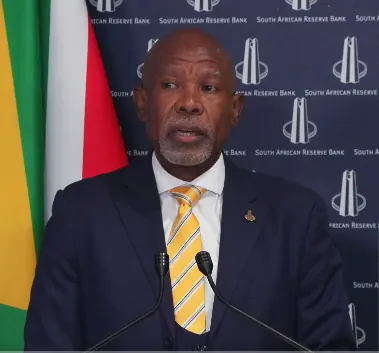
The South African Reserve Bank's Monetary Policy Committee (MPC) has raised the repo rate to 7.25%, a 25 basis point increase, as announced by Governor Lesetja Kganyago. This decision, effective 25 September, is aimed at addressing the country's inflation concerns. The MPC has taken a measured approach to setting rates amid heightened uncertainty while remaining focused on its price-stability mandate.
According to Governor Kganyago, the inflation outlook faces upside risks, with current inflation at 4.4%. Although inflation expectations have eased slightly, they remain high, with longer-run expectations around 4%, above the 3% target. The MPC is concerned that the fuel-price shock has intensified, and global rates are moving higher, contributing to inflationary pressures.
The MPC's decision is based on various factors, including a challenging and uncertain global environment. Global supply chains are being disrupted by intensifying conflict in the Middle East and the Russia-Ukraine war, adding to inflationary pressures. Central banks in major economies are raising rates in response to these challenges.
The South African economy is also feeling the effects of global shocks. Despite a contraction in the second quarter, the economy is expected to rebound in the second half of the year. Annual growth is now projected at 1.2%, revised down from 1.4%. Inflation is expected to remain elevated through 2027, driven largely by fuel and services inflation.
Governor Kganyago noted that fuel prices have begun rising again after moderating between June and August, while services inflation remains elevated. However, food inflation is at its lowest level since 2010, reflecting strong harvests and more stable meat prices. The rand has stayed resilient, helping contain import prices.
The MPC considered various scenarios, including one involving higher global interest rates and another with higher inflation expectations and wage increases. Both scenarios pointed to a tighter policy stance, with the policy rate rising above the baseline path. The MPC's primary role is to protect the currency's value by bringing inflation back to 3% over time.
The MPC's approach is to look through the initial effects of price shocks while ensuring that they do not entrench higher inflation. The committee is adopting a more restrictive monetary policy, with rates above longer-term levels, to prevent second-round effects and maintain price stability. The forecast from the Quarterly Projection Model shows the policy rate broadly stable through the remainder of this year, with cuts later in the forecast as inflation falls to 3%.
Key points
- The Monetary Policy Committee has raised the repo rate to 7.25% to address inflation concerns.
- The MPC's decision is aimed at maintaining price stability amid a challenging global environment.
- Inflation is expected to remain elevated through 2027, driven by fuel and services inflation.