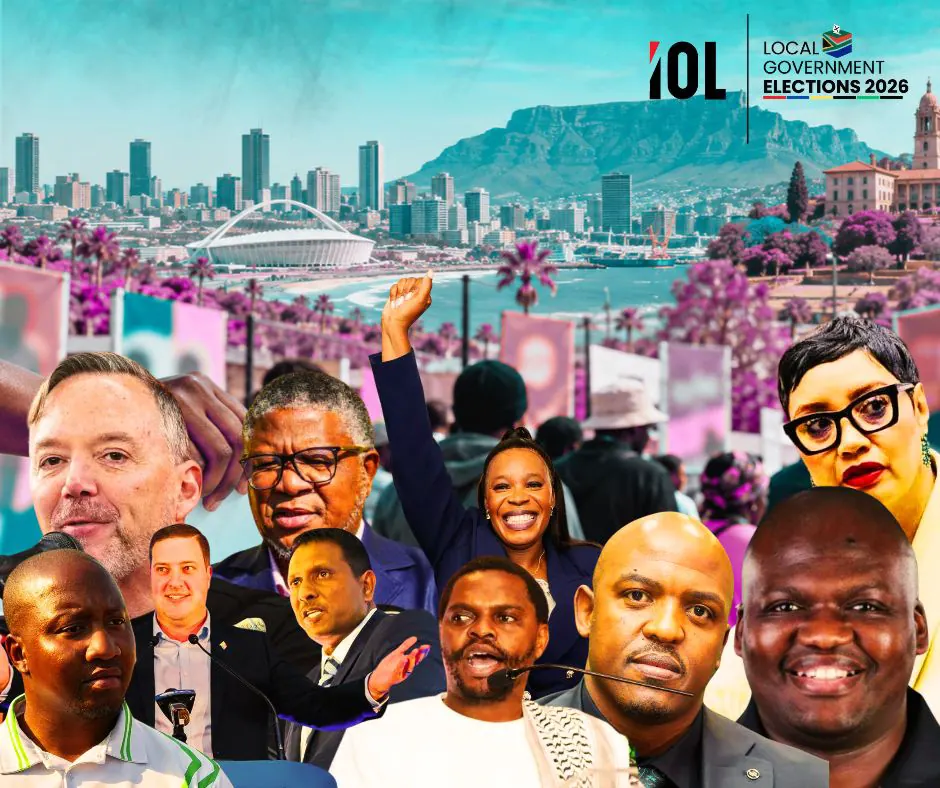
With just over a month until South Africa's November 4 Local Government Elections, the battle for the country's major metros is intensifying. The African National Congress (ANC) and the Democratic Alliance (DA) are facing closely contested races in several cities, while the MK Party has emerged as a major contender in eThekwini. Ipsos polling shows that the ANC and DA are closely matched in Johannesburg, Ekurhuleni, Nelson Mandela Bay, and Buffalo City.
The ANC has yet to announce its final mayoral candidates for any of the country's eight metropolitan municipalities, despite months of speculation and an unusually public selection process. In August, the party unveiled 42 potential candidates, leaving its national officials to make the final selections. This has left the party entering the final stretch of the campaign with its mayoral line-up still unresolved in several key battlegrounds.
The latest Ipsos polling paints different pictures across the metros. In Johannesburg, the ANC and DA are closely matched, with ActionSA also recording double-digit support. In eThekwini, the MK Party has recorded 55% support among voters expressing a party preference. In Cape Town, the DA records 46% support, while in Buffalo City, the EFF reached 27% support. The Ipsos findings are based on interviews with 3,600 South Africans conducted in June and July.
Political analysts say that the final council make-up may be as important as which party comes out on top, with coalition governments likely to play a significant role in several metros. UKZN political analyst Dr Siyabonga Ntombela identified Johannesburg, Ekurhuleni, and Nelson Mandela Bay as metros where the contest could be particularly close. He noted that the DA had made gains in Johannesburg following Helen Zille's mayoral candidacy.
In Tshwane, Ntombela said the DA was the "favourite", citing various polls that placed the party between 31% and 43%. He added that the DA could convert a near-tie into a clear lead. Meanwhile, ActionSA recorded double-digit support in Tshwane, according to Ipsos polling. In Ekurhuleni, the contest remains difficult to assess between the ANC and DA, with ActionSA also recording double-digit support.
In eThekwini, the MK Party's 55% support among voters expressing a party preference has significant implications for the contest. Ntombela said that while MK would have the lion's share, it would need one or two smaller parties to co-govern with. He added that the prospect of an outright majority was dimly-lit. The metro has 69 parties contesting the proportional representation ballot.
The outcome of the elections could have significant implications for the governance of South Africa's major metros. According to Professor Theo Neethling, a research fellow in the Department of Political Studies and Governance at the University of the Free State, no party should assume it would secure an outright majority in the major metros. He noted that this was particularly true for Johannesburg, Tshwane, and Ekurhuleni, where no party had managed to govern alone since 2016.
Key points
- The ANC and DA are closely matched in several major metros, including Johannesburg and Ekurhuleni.
- The MK Party has emerged as a major contender in eThekwini, with 55% support among voters expressing a party preference.
- Coalition governments are likely to play a significant role in several metros, with the final council make-up potentially being as important as which party comes out on top.