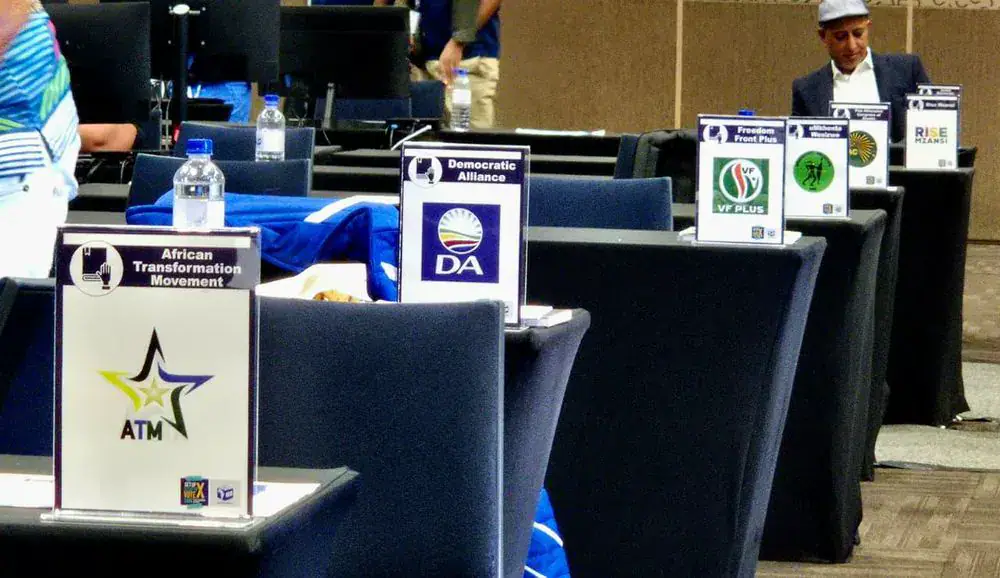
The South African local government elections have left 69 out of 100 councils without a clear winner, as the counting of votes reached 63% on Thursday night. The African National Congress (ANC) had secured 21 councils outright, while the Democratic Alliance (DA) won six and the MK Party secured three. With 113 councils still to be calculated, the stage is set for intense coalition talks and power struggles among various political parties. The ANC currently stands at 31.65%, the DA at 25.25%, and the MK Party at 8.48% nationally.
The elections have redrawn South Africa's political landscape, with the ANC's support base dropping to around 32%, its worst showing since 1994. According to political analyst Prof André Duvenhage, this marks a significant shift in the country's politics. ActionSA has emerged as a surprise package, performing well in urban areas and likely to play a major role in coalition talks. Duvenhage noted that ActionSA's performance is noteworthy, especially in urban areas, making it a key player in the negotiations.
The battle for control of major metropolitan areas will largely be decided at the bargaining table. In Johannesburg, the DA leads with 40.61% of the votes counted, while the ANC and ActionSA are closely contesting second place. Similarly, in Tshwane, the DA is in the lead, with ActionSA and the ANC closely following. ActionSA's Matthew George has made it clear that the party intends to be a kingmaker in coalition formations, emphasizing the need for partners to commit to tackling illegal immigration, corruption, and delivering services fairly.
Outside the metropolitan areas, the DA has made significant inroads in various municipalities. In Emfuleni, which includes Vereeniging and Vanderbijlpark, the DA leads with 49.12% of the votes. The party has also extended its grip on Midvaal with 63.61%. In KwaZulu-Natal, the MK Party is in the lead with 33.88% of the votes counted, followed by the IFP and the ANC. The MK Party has won three councils outright and is the largest party in five others.
The MK Party has made significant gains in eThekwini, with 42.95% of the votes counted so far. The DA follows with 21.02%, the ANC with 16.56%, and the IFP with 9.2%. In Msunduzi, the DA is in the lead with 37.52%, while the MK Party and the ANC trail behind. MK Party spokesperson Sifiso Mahlangu emphasized that the party will not compromise its principles for positions, seeking coalitions with parties that share its beliefs.
In the Eastern Cape, the ANC has secured 46.83% of the votes counted, below its traditional majority. The DA follows with 18.2%, while the SACP, contesting separately from the ANC, secured 6.14%. The UDM has performed well in several municipalities, including Mbhashe, Buffalo City, and King Sabata Dalindyebo. UDM's Yongama Zigebe expressed confidence in the party's growing support, emphasizing that clean governance and the fight against corruption will be non-negotiable in any coalition deal.
As coalition talks begin, parties are outlining their conditions for partnerships. ActionSA's Matthew George emphasized the need for partners to commit to key issues. UDM's Yongama Zigebe stated that the party will prioritize clean governance and the fight against corruption. The final results and coalition agreements will determine the leadership of various municipalities, with several councils awaiting the outcome of negotiations among political parties.
Key points
- The ANC's support base has dropped to around 32%, its worst showing since 1994.
- ActionSA has emerged as a surprise package, performing well in urban areas.
- Coalition talks will determine the leadership of various municipalities, with several councils awaiting the outcome of negotiations among political parties.