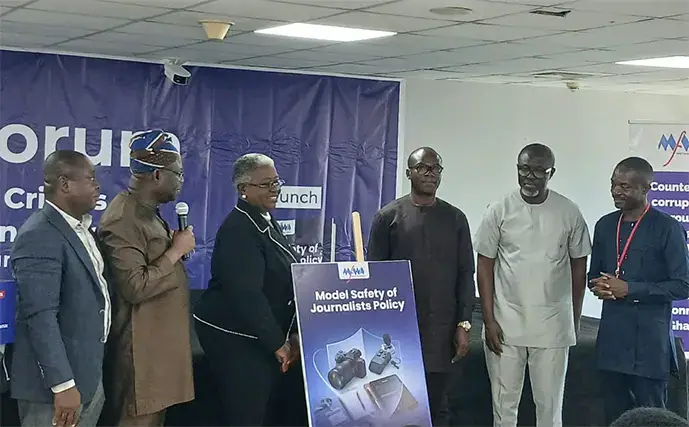
The Media Foundation for West Africa (MFWA) has called on media organisations in Ghana to adopt and implement journalists' safety policies. This call was made at a public forum on "Ending Impunity for Crimes against Journalists in Ghana: Strengthening Safety, Accountability and Press Freedom" and the launch of Model Safety of Journalists Policy in Accra. The policy aims to protect media practitioners from physical attacks, intimidation, online harassment and other threats associated with their work.
Former President of the Ghana Journalists Association (GJA), Mrs. Gifty Afenyi-Dadzie, Esq, described journalists' safety as a fundamental requirement for democracy. She stressed that attacks on journalists undermine not only press freedom but also the public's right to information and accountability. Journalists who investigate corruption, expose illegal mining and question public officials perform an important democratic role.
Mrs. Afenyi-Dadzie emphasised that protecting journalists must be a shared responsibility involving government, law enforcement agencies, media owners and civil society organisations. When journalists are intimidated into silence, the public loses its eyes and ears. She noted that when attacks against journalists go unpunished, the entire society pays the cost.
Research by University of Media, Arts and Communications (UniMAC-IJ) lecturer, Dr. Martin Thompson Ntem, found that approximately 81 per cent of respondents had experienced some form of attack. These attacks included verbal abuse, physical assault, online harassment, legal threats and the seizure of journalistic equipment. The research also revealed gaps in safety arrangements within Ghanaian media organisations.
Dr. Ntem highlighted that even though some respondents indicated that their organisations had safety policies, further examination of the documents showed that none of the media houses assessed had a comprehensive, formal journalists' safety policy. Some organisations mistook employment conditions, staff contracts and collective bargaining agreements for comprehensive safety policies.
The Minister for Communication, Digital Technology and Innovations, Samuel Nartey George, Esq, called on media organisations to strengthen professional self-regulation. He stressed that the media industry must take responsibility for maintaining ethical standards rather than creating room for excessive government regulation. He outlined measures for media organisations and professionals, including enforcing codes of ethics and sanctioning members who breach professional standards.
The Model Safety of Journalists Policy provides guidance on assessing risks before assignments, identifying high-risk environments, responding to emergencies and assigning clear safety responsibilities. The minister assured stakeholders that efforts to combat disinformation would not be used as an excuse to suppress legitimate criticism, investigative journalism or freedom of speech.
Key points
- Media organisations in Ghana are urged to adopt and implement journalists' safety policies to protect practitioners from physical attacks and intimidation.