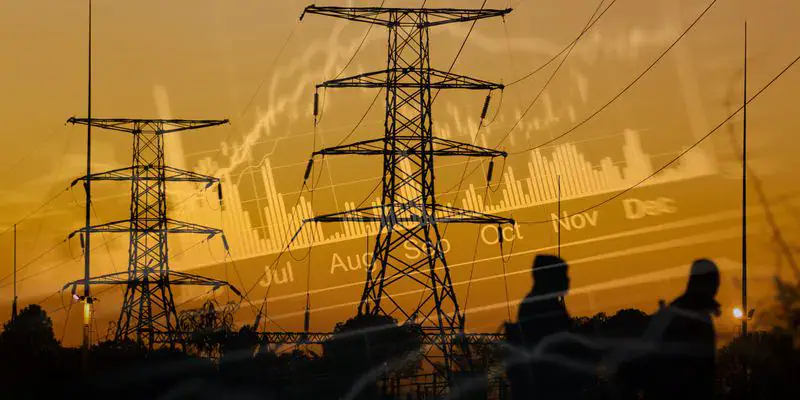
South Africa's National Transmission Company South Africa (NTCSA) recently released its Medium-Term System Adequacy Outlook (MTSAO) for 2027-2036, predicting that the country can largely avoid renewed electricity shortages over the next decade. However, this optimistic outlook is contingent upon several factors, including Eskom's sustained generation recovery, replacement capacity arriving on schedule, and the transmission grid expanding as planned. The report's Reference Case assumes high electricity demand growth, improving Eskom plant performance, substantial new renewable energy and storage, major transmission upgrades, and new gas-fired generation from 2032.
The MTSAO Reference Case projects annual sent-out electricity to increase to 329.7 TWh and peak demand to 49.1 GW by 2036, compared with 238.3 TWh and 35.8 GW in 2026. This demand projection underscores the importance of delivering new generation to replace ageing generation due for retirement. By 2036, the Reference Case still records 13.42 GWh and 377 hours of unserved energy – hours in which some demand cannot be met. The study's hourly, network-constrained simulations are a significant modelling advance, but the results are conditional outcomes that are not stated with any degree of certainty.
A critical assumption in the MTSAO Reference Case is Eskom's energy availability factor (EAF) rising from 66% in financial year 2027 to 70% by 2031, remaining there through to 2036. However, maintaining 70% on a shrinking, ageing fleet is not assured. Eskom's recent improvement is noted, with EAF recovering from 56% in financial year 2023 to 66% in 2026. The timing of coal shutdowns, life extensions, and replacement projects needs careful scrutiny to ensure that Eskom's performance targets are met.
The MTSAO report assumes about 16.2 GW of Eskom capacity is shut down by 2036, including 8.75 GW in 2029 and 2030. Coal stations dominate the retirements, although two diesel peaking plants are also included. Contracts for 1,150 MW from Cahora Bassa and 1,005 MW from the Avon and Dedisa peakers are assumed to expire in 2030. A further about 3 GW of existing renewable projects reach the end of their assumed operating or contractual period between 2033 and 2036.
The Department of Electricity and Energy confirmed that Gas IPP Procurement Programme Bid Window 1 had produced no preferred bidders, as four bids totalling 2,830 MW had been submitted for 2,000 MW sought, but none met mandatory requirements. This failure to attract investors is significant, as South Africa lacks an operational liquefied natural gas import terminal, and the fuel-supply challenge applies beyond the failed IPP bids to the broader gas build programme to meet industrial gas demand.
The MTSAO acknowledges that the October 2026 developments, including the failed gas procurement round, were not incorporated into its June 2026 model inputs. The final chapter on the MTSAO 2027-2036 report warns that gas delivery risk has increased and that the Reference Case outcomes from 2032 should be treated with greater caution. The Perfect Storm scenario illustrates the combined downside vulnerability, but it does not establish that the full 9.75 GW gas programme is indispensable or that failure to deliver it would, by itself, recreate a national electricity crisis.
The MTSAO Accelerated Build scenario provides a useful contrast, with lower demand, higher EAF, more rapid generation development, and greater uptake of embedded generation largely eliminating adequacy shortfalls. However, this scenario includes new gas capacity, so it is not a test of a renewables-and-storage system without gas. The MTSAO Reference Portfolio itself already envisages 17.7 GW of solar PV and 22.1 GW of wind.
Key points
- Eskom's sustained generation recovery is crucial to South Africa's optimistic electricity outlook.
- The country's gas procurement programme has failed to attract investors, increasing gas delivery risk.
- The MTSAO Reference Case assumes high electricity demand growth and substantial new renewable energy and storage.