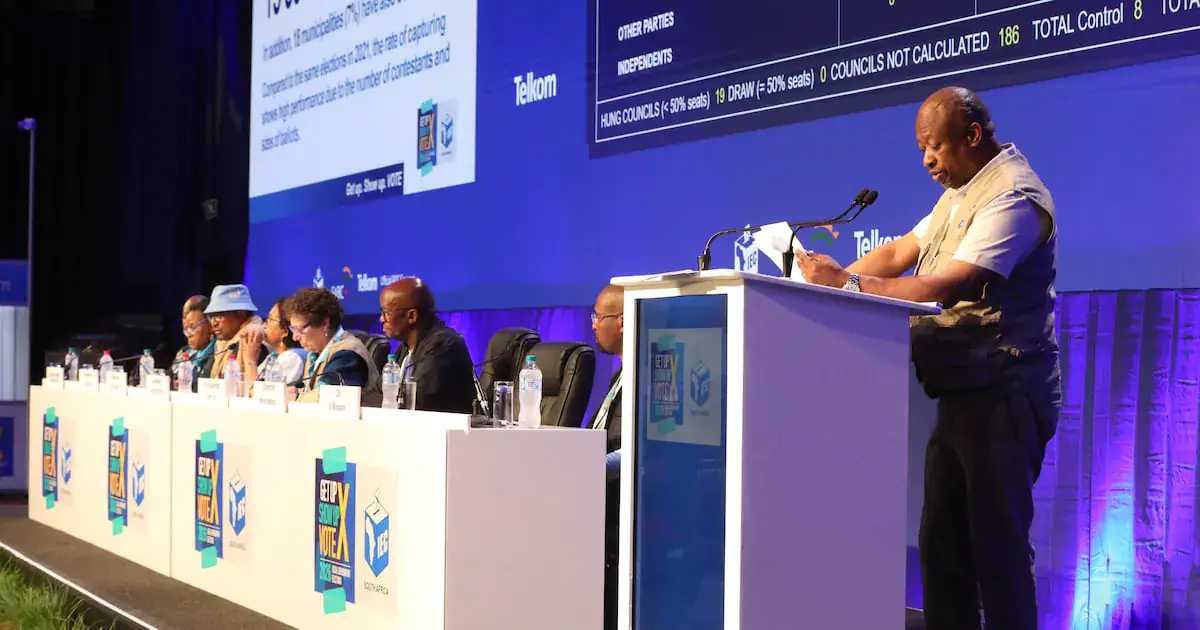
The 2026 South African local government elections are underway, with the Electoral Commission of South Africa (IEC) reporting significant progress in capturing and verifying results. As of 5 pm on November 5, 2026, more than 60% of the results had been captured. The Northern Cape is leading in terms of results capture, with 87% of its results processed. IEC chief electoral officer Sy Mamabolo expressed satisfaction with the steady progress being made.
The Democratic Alliance (DA) is maintaining its dominance in the Western Cape, with 53.4% of the provincial vote, followed by the African National Congress (ANC) on 14%, the Patriotic Alliance (PA) on 11.1%, and the Freedom Front Plus on 5.4%. With 50% of the province's 1,623 voting districts counted, the DA has secured majority control of at least four out of 24 local municipalities. However, there are at least 13 hung councils in the province, which will require coalition arrangements.
ActionSA leader Herman Mashaba outlined conditions for his party to enter into a coalition with another party. Speaking on the sidelines of the national results centre in Johannesburg, Mashaba emphasized the importance of these conditions being met. Meanwhile, ANC's Nomvula Mokonyane expressed confidence in the party's renewed efforts, stating that voters still have faith in the ANC.
The African Transformation Movement (ATM) has taken a firm stance on coalition deals, stating that it will not consider entering into coalitions with parties it deems corrupt or whose principles do not align with its own. ATM national chairperson Mandisa Mashiya emphasized this stance, highlighting the party's commitment to integrity.
The DA's victory projection in the City of Cape Town has sparked mixed reactions from rival parties. The party claimed victory based on its election projections, but other parties have urged patience, emphasizing that the IEC has not yet completed its counting process. DA mayor Geordin Hill-Lewis announced the party's claim of victory outside the IEC results centre in Century City.
As results continue to trickle in, parties are positioning themselves for potential coalition negotiations. ActionSA national chairperson Michael Beaumont reflected on the party's performance and growing influence, particularly in Gauteng. The party appears to be gaining ground in the City of Tshwane, which could impact future coalition arrangements.
Key stakeholders continue to engage with the electoral process. MK Party deputy president Duduzane Zuma addressed concerns about the party's frequent reshuffling of positions, emphasizing that potential coalition partners should be prepared to adapt. The IEC anticipates completing the results collation process by the weekend, with final results expected to be announced in the coming days.
Key points
- The Northern Cape leads in capturing election results with 87% of its results processed.
- The DA maintains dominance in the Western Cape, but coalition arrangements loom in several councils.
- Parties are positioning themselves for potential coalition negotiations as results continue to emerge.