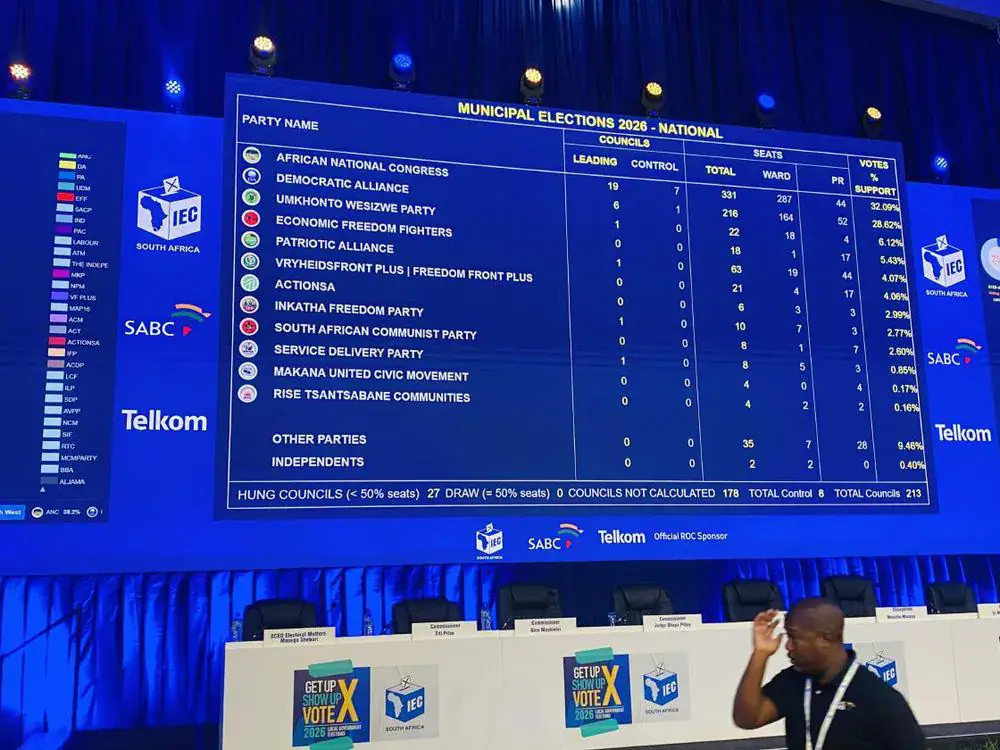
The 2026 local government elections in South Africa have delivered qualified outcomes, with the African National Congress (ANC) losing much of its historical political authority. The ANC's decline has created space for other parties to fill, including the Democratic Alliance (DA) which strengthened its electoral position. However, the DA's growth should not be confused with decisive national realignment. The elections exposed a deeper contest over who can translate political freedom into economic participation, accountable government, and inclusive prosperity.
The ANC no longer holds an exclusive claim to the liberation tradition, with the MK Party and the Economic Freedom Fighters (EFF) advancing their own interpretations of that history. The MK Party has mobilised a substantial constituency around its own interpretation of liberation history, while the EFF advances its own economic emancipation proposition. These distinct formations demonstrate that liberation remains a significant force even as the ANC's authority is contested.
The DA's growth deserves recognition, but its ability to extend appeal across historically excluded communities remains the central test. Historical arithmetic and non-participation also played a significant role in the elections. In 1994, combined support for the National Party, Democratic Party, Freedom Front, and IFP was approximately 34.8%. In 2026, combined support for the DA, Freedom Front Plus, and IFP was approximately 32.3%.
The elections saw a turnout of roughly 54.5%, with about 15.9 million voters participating out of 29.2 million registered voters. About 13.3 million registered voters did not cast ballots, with non-participation not invalidating the election. Parties can legitimately form governments while still confronting whether they represent the aspirations of the eligible population.
In Tshwane, the DA secured 74 council seats, ActionSA 48, and the ANC 44. ActionSA has consolidated itself as a significant metropolitan force, with Dr Nasiphi Moya's mayoralty giving the party a visible governing platform. ActionSA's challenge is to demonstrate that commitments to clean administration, professional municipal management, and economic opportunity produce measurable improvements.
ActionSA is positioning itself to challenge the DA and IFP's space, combining Black political representation with private enterprise, anti-corruption politics, market-oriented development, and inclusive prosperity. The party seeks to become a gateway between the unfinished promise of liberation and a market-friendly development model. ActionSA's emergence could shape the future of the DA, IFP, and the ANC's strategic choices.
The ANC confronts a choice beyond mayoral allocations: Does it continue accommodating an arrangement where the DA's market-oriented preferences exert considerable influence over national and local governance? Or does it reconsider its relationship with the broader liberation tradition and explore a coalition around a different development agenda? A wider coalition involving the ANC, MK Party, SACP, and other left-oriented formations deserves serious consideration.
Key points
- The ANC's declining electoral authority has made coalitions central to its future.
- ActionSA's emergence could shape the future of the DA, IFP, and the ANC's strategic choices.
- The elections exposed a deeper contest over who can translate political freedom into economic participation, accountable government, and inclusive prosperity.