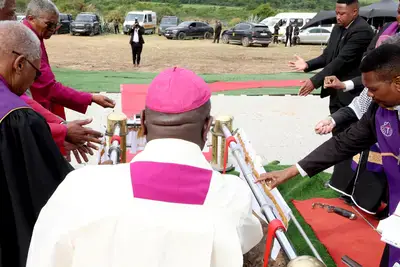
The rural town of Xesi in the Eastern Cape was filled with local and foreign dignitaries on Saturday as South Africa bid farewell to its first woman president, Dr Phumzile Mlambo-Ngcuka. Mlambo-Ngcuka was laid to rest with a Category 2 State Funeral at the Ann Shaw Village, her coffin draped with a South African flag and a large framed portrait of her. The town of Xesi, shaped by century-long Frontier Wars and resistance to the apartheid-era Ciskei homeland, witnessed an outpouring of tributes to Mlambo-Ngcuka in speech, poetry, song, brass band, and military salute.
Former President Thabo Mbeki delivered a scathing critique of the current ANC leadership, saying they have failed to address the party's decline in electoral support. Mbeki noted that the ANC's support had dropped from 70% to 57% in 2019, down to 40% in 2024, and further to 30% in the 2026 local government elections. He urged the party to confront its failures and recover from what he termed an "electoral disaster". Mbeki said Mlambo-Ngcuka, who spent most of her life building the ANC, would have been heartbroken to see South Africans deserting the party in large numbers.
Mbeki praised Mlambo-Ngcuka's contributions to the ANC, highlighting her role in mobilizing support for the party and her work in government. He noted that she was part of a special crop of MPs in the Parliament of 1994 to 1999 and played a key role in the Constitutional Assembly. Mbeki also recalled her tenure as deputy minister of Trade and Industry, minister of Minerals and Energy, and deputy president, saying she performed exceptionally well in these roles.
President Cyril Ramaphosa, in his keynote speech, chose not to respond to Mbeki's criticism of the ANC, instead focusing on Mlambo-Ngcuka's achievements. Ramaphosa said her life was "about breaking barriers and opening doors that had been closed to women and to black South Africans for generations". He highlighted her trailblazing roles as the first black woman to serve as Minister of Minerals and Energy, the first woman to become deputy president of South Africa, and the first African to head UN Women.
Ramaphosa emphasized that Mlambo-Ngcuka's greatness was not defined by the positions she held, but by what she did with the opportunities she was given. He noted that she used her platforms to improve the lives of others, particularly those who had been excluded. Ramaphosa also highlighted her work in the mining industry, where she challenged the legacy of colonialism and apartheid and sponsored laws that opened up access to mineral wealth.
UN Deputy Secretary-General Amina Mohammed paid tribute to Mlambo-Ngcuka, describing her as "a tireless champion of women's rights who never stopped fighting and consistently made room at the table for other women". Mohammed called Mlambo-Ngcuka "our touchstone, a giant on whose shoulders we stood" and "my sister". Mlambo-Ngcuka's legacy as a champion of women's rights and a fighter for the poor continues to inspire.
The funeral of Phumzile Mlambo-Ngcuka serves as a reminder of her lasting impact on South Africa and the world. Her dedication to fighting poverty and promoting women's rights has left a lasting legacy. As the country continues to grapple with high unemployment and poverty, Mlambo-Ngcuka's contributions to the ANC and her work in government serve as a testament to her commitment to creating a better life for all South Africans.
Key points
- Mlambo-Ngcuka was a trailblazer for women in South Africa, holding several groundbreaking positions, including Minister of Minerals and Energy, deputy president, and head of UN Women.
Reporting sources
- Fitting Xesi tribute to Mlambo-Ngcuka – fighter for the poor · Mail & Guardian