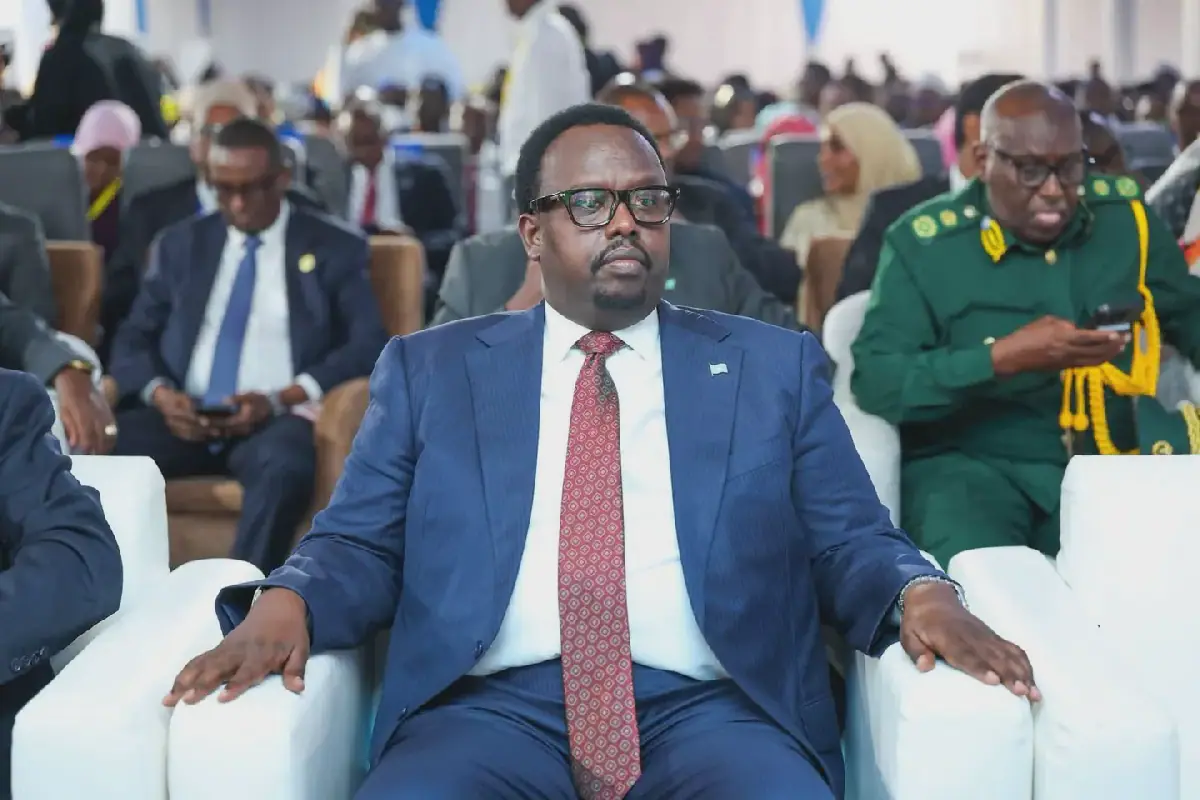
The recent inauguration of Galmudug State President Liban Ahmed Hassan in Dhuusamareeb on November 5, 2026, marked the third peaceful transfer of power in the federal member state, which celebrated its 20th anniversary this year. The event was attended by dignitaries, including Deputy Prime Minister Salah Ahmed Jama and Second Deputy Speaker of the Upper House Abdullahi Ali Hersi. Their exchange highlighted the complexities of Somalia's history and the Somaliland administration's secessionist claims.
Salah Ahmed Jama stated that Northerners had come to Mogadishu as one entity to unite with the South and establish the Somali Republic. Abdullahi Ali Hersi acknowledged the historical fact of the union but emphasised its legal foundations, upon which the sovereignty of the Federal Republic of Somalia rests. This exchange underscores the ongoing debate about Somaliland's status and its implications for Somalia's territorial integrity.
The Somaliland administration's persistence in shelling Laascaanood during the six-month conflict in 2023 has raised questions about its commitment to peaceful resolution. The secessionist administration presented a two-state solution as a precondition for reaching a peace agreement, which was rejected by the Federal Government of Somalia. This move was seen as an attempt to deprive unionist Somalis of their citizenship rights in the Federal Republic of Somalia.
The Somaliland administration's claim to restore the former colonial boundary between British Somaliland and the Trust Territory of Somaliland under Italian administration has been disputed. The Federal Government of Somalia did not denounce the Somaliland administration's claim that its territory served as a buffer zone for Ethiopia. This claim was followed by a memorandum of understanding in 2024 that envisaged leasing a Somali coastal district to Ethiopia, which has raised concerns about Somalia's sovereignty.
The Somaliland administration's invocation of colonial borders raises fundamental questions about the interpretation of Article 4(b) of the Constitutive Act of the African Union. The African Union recognises the principle of respecting international borders inherited at independence. However, Eritrea and South Sudan, which became independent from Ethiopia and Sudan in 1993 and 2011 respectively, achieved independence through internationally recognised processes involving negotiated arrangements and referendums.
The historical arguments advanced by Somali secessionists must be examined alongside the legal foundations of Somali sovereignty and the African Union's commitment to territorial integrity. These considerations expose significant weaknesses in the argument for dividing Somalia into two sovereign states. The African Union's commitment to territorial integrity is a cornerstone of its principles, and Somaliland's unilateral declaration of independence in 1991 is not recognised by the international community.
The debate over Somaliland's status and Somalia's territorial integrity is ongoing, with implications for regional stability and international relations. The Federal Government of Somalia has not recognised Somaliland as a separate state, and the international community has not taken a clear stance on the issue. As the situation continues to evolve, it remains to be seen how the African Union and the international community will address the complexities of Somalia's history and the Somaliland administration's secessionist claims.
Key points
- The Somaliland administration's claim to colonial borders fails to meet African Union standards, which emphasise the principle of respecting international borders inherited at independence.
- The African Union's commitment to territorial integrity is a cornerstone of its principles, and Somaliland's unilateral declaration of independence in 1991 is not recognised by the international community.
- The debate over Somaliland's status and Somalia's territorial integrity has implications for regional stability and international relations.