The Horn of Africa is experiencing a volatile period marked by historical conflicts, geopolitical rivalries, and rapidly evolving security dynamics. Ethiopia's accelerated military modernization has sparked concerns over a potential regional arms race. Ethiopia's acquisition of Russian Su-35 fighter aircraft and planned S-400 air-defense systems has raised concerns among neighboring countries. Somalia, which occupies a vital geographic position along the Indian Ocean and Gulf of Aden, must navigate these developments while protecting its sovereignty and territorial integrity.
Somalia faces a fundamental national security challenge: protecting its sovereignty, territorial integrity, natural resources, and national interests across an extensive geographical area. The country requires a well-organized, adequately equipped, and professionally trained national defense force. Somalia's geographical position presents significant security responsibilities, including a 3,300-kilometer coastline, extensive land borders exceeding 2,400 kilometers, and a maritime Exclusive Economic Zone (EEZ) of approximately 1.07 million square kilometers.
To protect its assets, Somalia's national security policy must address three interconnected dimensions: land security, maritime security, and internal security. Land security involves protecting national sovereignty, territorial integrity, and internationally recognized borders through effective border management and professional security institutions. Maritime security involves protecting territorial waters, fishing resources, commercial shipping routes, and offshore economic interests. Internal security involves strengthening national institutions, maintaining public order, and protecting citizens against terrorism, organized crime, and illegal trafficking.
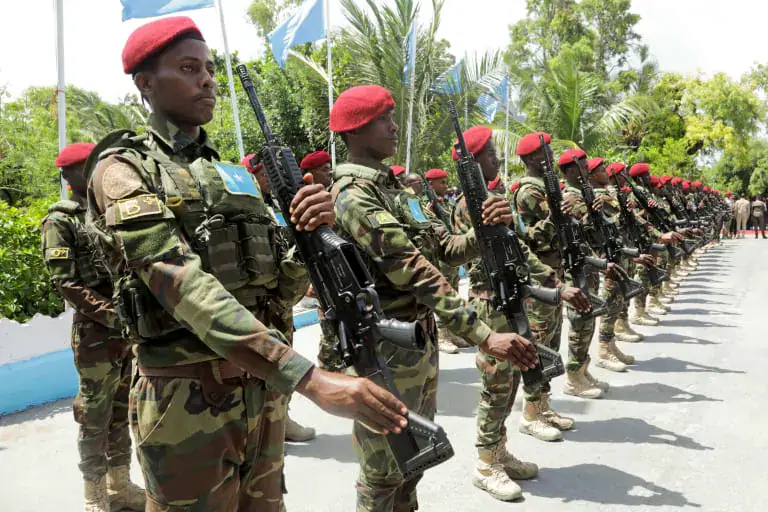
Somalia's defense structure should reflect its geographical size, security environment, and economic capacity. An initial planning estimate suggests an active military force of between 150,000 and 200,000 personnel. However, the appropriate size should be determined through a comprehensive national defense review, threat assessment, and evaluation of financial resources. The objective is to establish a professional, disciplined, and technologically capable military that protects national interests without placing an unsustainable burden on the national economy.
Somalia's history provides an essential reference point for rebuilding its national defense institutions. Civilian-era partnerships with the Soviet Union began in 1963 and provided equipment, technical assistance, and training. However, cooperation collapsed in 1977-1978 when the Soviet Union sided with Ethiopia during the Ogaden War. Future military development must remain firmly grounded in constitutional government, civilian oversight, and national unity.
The Horn of Africa and neighboring maritime regions are shaped by six main regional actors with distinct strengths, strategic priorities, and vulnerabilities. The acceleration of military spending and unilateral strategic moves in the Horn of Africa carries serious risks for the wider region, including a new regional arms race, Red Sea vulnerabilities, intensified foreign intervention, and socioeconomic diversion. Somalia should pursue a balanced and diversified international defense cooperation policy with countries such as China, Russia, Türkiye, and Egypt.
Somalia should engage these partners through transparent bilateral agreements aligned with its national interests, international obligations, and long-term defense requirements. Beyond equipment acquisition, cooperation must emphasize professional military education, training, and institutional development. This approach will enable Somalia to rebuild its national defense institutions and address internal security challenges while protecting its sovereignty and territorial integrity.
Key points
- Somalia needs a well-organized, adequately equipped, and professionally trained national defense force to protect its sovereignty and territorial integrity.
- The country must address three interconnected dimensions: land security, maritime security, and internal security.
- Somalia should pursue a balanced and diversified international defense cooperation policy with countries such as China, Russia, Türkiye, and Egypt.