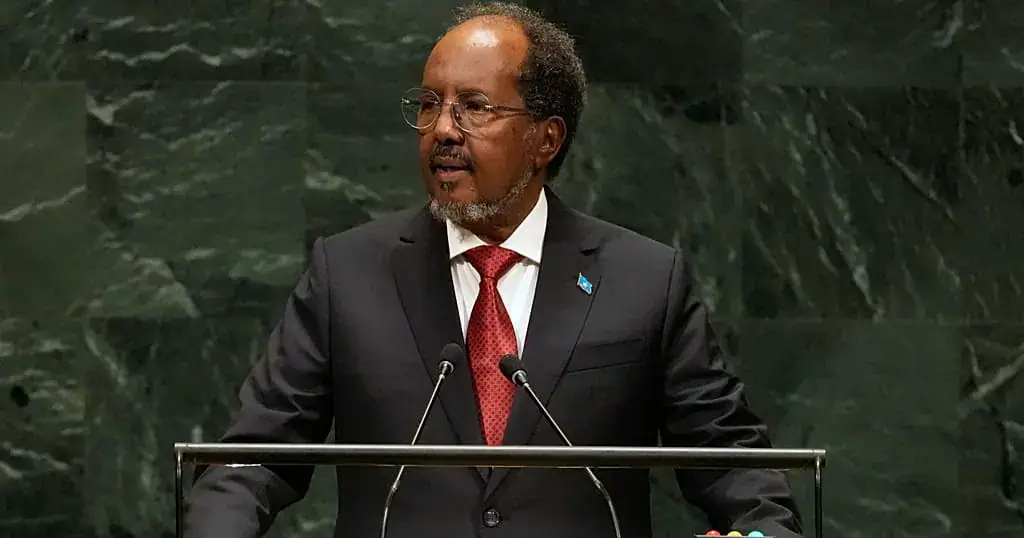
Somalia's Supreme Court has ruled that President Hassan Sheikh Mohamud's term extension was unlawful, plunging the country into a deepening political crisis. The court's decision has sparked mixed reactions among Mogadishu residents, with some supporting the ruling and others opposing it. The country is already grappling with multiple crises, including violent clashes between political rivals and a long-running insurgency by the Al-Qaeda-linked Al-Shabaab group.
President Mohamud had declared a "transition period" that gave him an extra year in office when his term ended in May. He argued that he was allowed to stay in office under constitutional amendments passed by parliament, but the Supreme Court disagreed. The court ruled that the amendments should never have applied to Mohamud's current term and that he should have left office in May. The court has called for a new agreement between political parties within 30 days and elections to be held within 90 days.
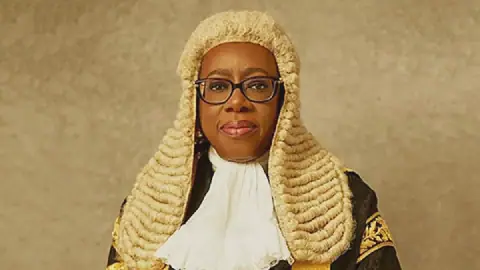
The president's office announced on Facebook that he was dismissing the chief justice, Bashe Yusuf Ahmed, and appointing a replacement, citing concerns about the need for an efficient and fair judiciary. However, the court responded that the president had no authority to fire the judge, accusing him of trying to obstruct the administration of justice. A former prime minister, Hassan Ali Khaire, claimed that the president had launched an assault on the Supreme Court and deployed troops to its premises.
The opposition and regional parties had boycotted the vote on amending the constitution when it went to parliament in March, with some claiming they were barred from attending. Violence broke out in Mogadishu in June as political factions clashed over the issue. The flare-up comes at a time when Somalia is facing a security crisis related to the Al-Shabaab insurgency, which controls swathes of the country.
International donors have been slashing funding for the international military mission that has been ongoing for almost 20 years, frustrated by the lack of progress against the militants and the endless political chaos. Uganda, the biggest contributor to the African Union's force, announced this week that it was pulling out all troops by the end of 2027. Washington has cut all donations to a critical United Nations logistics mission on which the military coalition relies.
The Supreme Court's decision has sparked concerns about the rule of law in Somalia. A Mogadishu resident, Abdullahi Hassan Sheikh, said that the court decision was right and that the rule of law must be respected. However, another resident, Mohamed Farah Ahmed, expressed a different view, saying that the court decision was wrong.
The country's future is uncertain, with many calling for calm and a return to stability. The international community is watching closely, with many urging the Somali leaders to find a peaceful solution to the crisis. The country's stability is crucial not only for its citizens but also for the region, as Somalia's instability has been a source of concern for neighboring countries.
Key points
- The Supreme Court's ruling that President Mohamud's term extension was unlawful has sparked a political crisis in Somalia.
- The opposition and regional parties had boycotted the vote on amending the constitution, leading to violent clashes in Mogadishu.
- International donors have been slashing funding for the international military mission, frustrated by the lack of progress against Al-Shabaab and the endless political chaos.