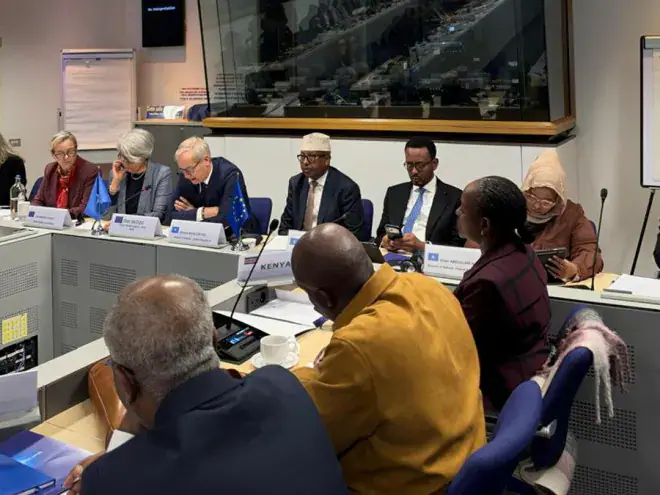
Somalia and the European Union jointly hosted a high-level security meeting in Brussels, bringing together representatives from 50 countries and international organizations. The meeting, held on November 19, focused on Somalia's security transition roadmap and the future of international military assistance. The discussions aimed to strengthen the country's security institutions ahead of a United Nations Security Council decision on the mandate of the African Union Support and Stabilization Mission in Somalia (AUSSOM) in December.
The meeting provided an opportunity for the Somali federal government to present its vision for taking full responsibility for national security while coordinating future support from international partners. Somali Defence Minister Ahmed Moallim Fiqi addressed the opening session, outlining the country's security situation, progress in the transition process, and the government's plans to assume greater security responsibilities. Fiqi emphasized the importance of continued international assistance to ensure an orderly transition that reflects Somalia's security priorities and operational needs.
Jihan Abdullahi Hassan, senior adviser to President Hassan Sheikh Mohamud on defense affairs, presented Somalia's security transition strategy, outlining the government's proposed framework for transferring responsibilities from international forces to Somali institutions. The meeting was co-chaired by Abdihakim Mohamed Yusuf, chief of staff to the Somali president, and Olof Skoog, deputy secretary-general for political affairs at the European External Action Service. Other participants included senior officials from AUSSOM, the EU, and troop-contributing countries.
The discussions come as AUSSOM faces uncertainty over its future financing and operations. The mission's current United Nations authorization expires on December 31, 2026, and the Security Council is expected to consider its renewal next month. Funding shortages have raised concerns about the ability of African Union forces to maintain operations and continue supporting Somali troops fighting al-Shabab.
AUSSOM, which replaced the African Union Transition Mission in Somalia in January 2025, supports Somali security forces in operations against al-Shabab and in protecting strategic locations. Despite years of military operations, al-Shabab continues to carry out attacks and maintain a presence in parts of southern and central Somalia. The European Union reaffirmed its commitment to supporting Somalia's peace, stability, and security, including a transition led and managed by Somali institutions.
Officials attending the Brussels meeting welcomed Somalia's proposed security transition framework and called for closer cooperation to ensure that progress is sustained. However, no final agreement on future security arrangements or new financial commitments was announced. The EU emphasized that a sustainable security framework would require broader political agreement among Somali stakeholders, highlighting the importance of an inclusive political settlement.
The meeting concluded with an agreement to continue technical and political consultations to develop a common understanding of the next steps. The EU and Somalia will maintain close coordination during the transition, with a focus on ensuring that Somalia's security priorities and operational needs are addressed. The outcome of the meeting will inform the UN Security Council's decision on AUSSOM's mandate in December.
Key points
- The meeting discussed Somalia's plan to assume full responsibility for national security and the future of international military assistance.
- AUSSOM's mandate is set to expire on December 31, 2026, and the Security Council is expected to consider its renewal next month.
- The EU reaffirmed its commitment to supporting Somalia's peace, stability, and security, including a transition led and managed by Somali institutions.