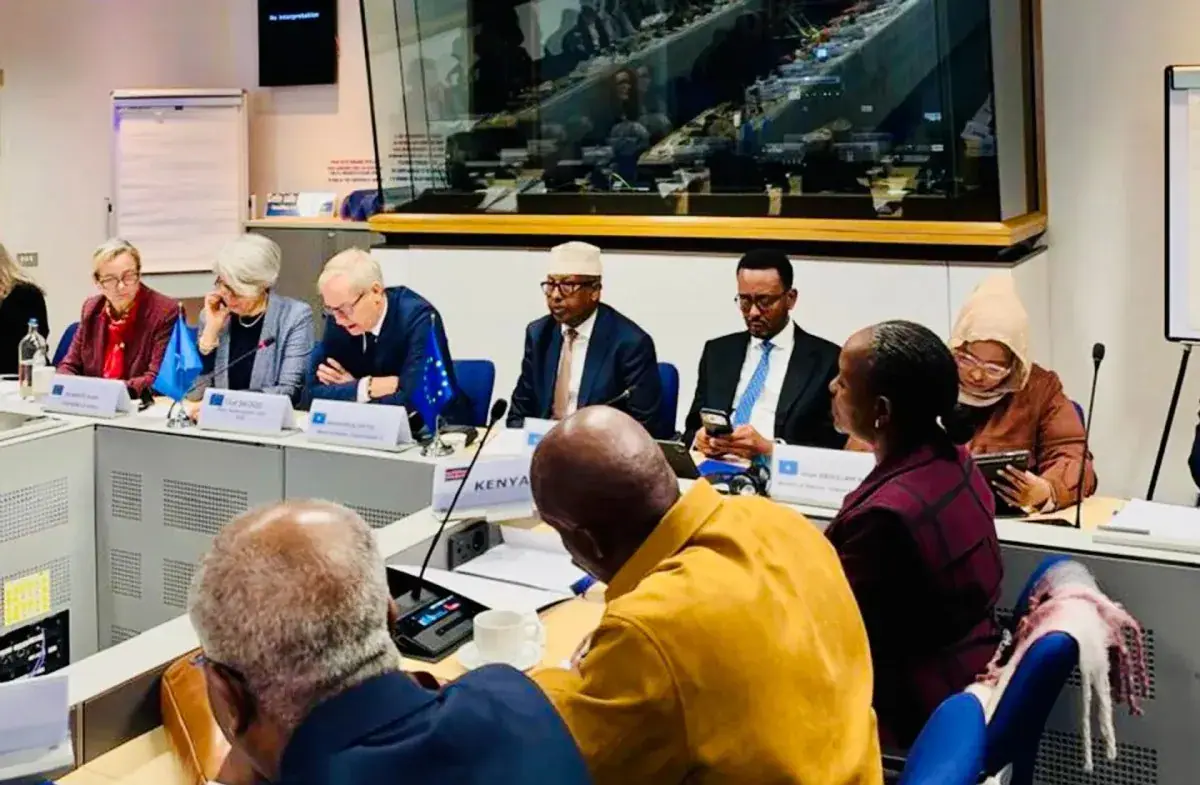
Somalia and the European Union recently held high-level talks in Brussels to discuss the country's future security arrangements. The meeting, jointly organised by Somalia and the EU, brought together African and international partners to discuss the next phase of Somalia's security transition. The Somali government outlined its vision and options for taking greater responsibility for national security, while international partners discussed coordination and future assistance.
The discussions contributed to preparations for the renewal of AUSSOM's mandate by the UN Security Council in December. Annette Weber, the EU Special Representative for the Horn of Africa, described the meeting as "an important milestone" in advancing discussions on Somalia's security transition. The EU reaffirmed its commitment to Somalia's peace and stability, stressing the importance of ensuring that the transition remains Somali-owned.
The meeting highlighted the importance of continued political and technical consultations to develop a common approach to Somalia's future security arrangements. Participants agreed on the need to maintain close coordination in the coming period. They also noted the importance of advancing an inclusive political settlement, recognising that a sustainable security architecture is best underpinned by broader political agreement.
Ambassador El Hadji Ibrahima Diene, the African Union's Special Representative for Somalia and head of AUSSOM, welcomed progress in the country's security sector. He highlighted cooperation between Somalia's Federal Government and the African Union, including joint operations involving Somali security forces and AUSSOM personnel. Diene also pointed to continued assistance from international partners as an important part of the country's ongoing security transition.
The meeting was co-chaired by Olof Skoog, the EEAS Deputy Secretary-General for Political Affairs, and Abdihakim Mohamed Yusuf, Chief of Staff to Somalia's President. Senior representatives from the United Nations, African Union, EU member states and AUSSOM troop-contributing countries attended, including Djibouti, Ethiopia, Kenya and Uganda, alongside representatives from Egypt, Türkiye, the United Kingdom, the United States, Saudi Arabia, Qatar and Kuwait.
Somalia seeks to strengthen its national security forces and gradually assume greater responsibility for security operations, while continuing to rely on international support. The discussions come as international partners prepare for a United Nations decision on the mandate of AUSSOM. No final agreement on future security arrangements was announced following the Brussels meeting. Further consultations are expected ahead of the UN Security Council's consideration of AUSSOM's mandate in December.
The outcome of the Brussels meeting will shape the next phase of Somalia's security transition. A decision on AUSSOM's mandate will be crucial in determining the level of international support Somalia receives in the future. The country's security transition is ongoing, with Somalia working to assume greater responsibility for its national security. International partners, including the EU and African Union, continue to play a significant role in supporting Somalia's security efforts.
Key points
- The EU and Somalia hold high-level talks in Brussels to discuss the country's future security arrangements and the mandate of AUSSOM.
- The meeting aims to advance discussions on Somalia's security transition and ensure that the transition remains Somali-owned.
- The outcome of the Brussels meeting and the UN Security Council's decision on AUSSOM's mandate will shape the next phase of Somalia's security transition.