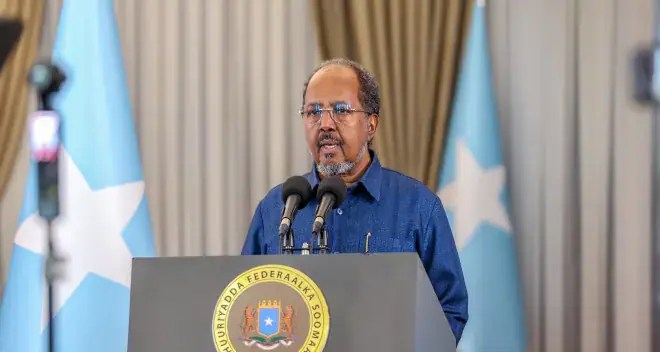
Somali President Hassan Sheikh Mohamud has accused the United Arab Emirates (UAE) of interfering in Somalia's internal affairs, providing financial and security support to factions that weaken the central government and undermine state institutions. In a televised address to the nation on November 17, Hassan Sheikh claimed the UAE had established military bases outside federal government control and supported regional administrations opposed to Mogadishu. He warned that such activities risk deepening political divisions as Somalia fights al-Shabab and rebuilds its security institutions.
Hassan Sheikh criticized agreements between the UAE and the administrations of Somaliland, Puntland, and Jubaland involving strategic ports such as Berbera, Bosaso, and Kismayo. He emphasized that these ports are national assets belonging to the Somali people and should be managed through the federal government. The president also questioned the UAE's position on Israel's recognition of Somaliland as an independent state in December 2025, which Somalia considers a violation of its territorial integrity.
The Somali president accused the UAE of pursuing a strategy of political fragmentation by supporting rival administrations and armed groups operating outside Somalia's national security framework. He claimed Abu Dhabi had developed security arrangements and military facilities in parts of Somalia without federal authorization, while providing financial and political assistance to regional authorities involved in disputes with Mogadishu. Hassan Sheikh warned against foreign governments using Somalia's internal political disagreements to advance their interests.
Hassan Sheikh also accused the UAE of facilitating the movement of a Yemeni separatist leader, Aidarous al-Zubaidi, through Berbera in January without Somalia's authorization. This allegation follows reports that al-Zubaidi traveled through Somaliland while fleeing Yemen amid tensions with Saudi Arabia. Somalia previously announced an investigation into the alleged unauthorized use of its airspace and airports in connection with the incident.
The president defended his government's January 12 decision to annul agreements with the UAE, including arrangements covering defense, security, and operations involving the ports of Berbera, Bosaso, and Kismayo. He also restricted Emirati military and cargo aircraft from using Somali airspace. Hassan Sheikh described these measures as necessary to protect Somalia's sovereignty, territorial integrity, and political independence.
Despite the diplomatic confrontation, Hassan Sheikh emphasized that Somalia holds no hostility toward Emirati citizens or Somalis living in the UAE. He said the government's objections are directed at the policies of the Emirati authorities rather than the people of the country. The president also expressed Somalia's willingness to restore cooperation with the UAE on the basis of mutual respect, equality, and recognition of Somalia's sovereignty.
The dispute between Somalia and the UAE comes amid growing competition for influence in the Horn of Africa, where Türkiye, Egypt, Saudi Arabia, and the UAE maintain significant interests. Somalia's federal government remains at odds with several regional administrations over constitutional amendments, power-sharing arrangements, and the electoral process. The confrontation with the UAE adds another dimension to these disputes as Somalia continues military operations against al-Shabab and prepares to assume greater security responsibilities from African Union forces.
Key points
- The UAE has previously denied accusations of interference in Somalia's internal affairs.
- Somalia's federal government remains at odds with several regional administrations over constitutional amendments and power-sharing arrangements.
- The dispute comes amid growing competition for influence in the Horn of Africa among Türkiye, Egypt, Saudi Arabia, and the UAE.