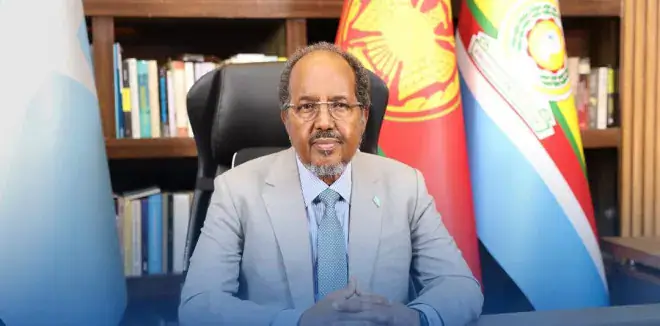
Somali President Hassan Sheikh Mohamud addressed the nation on Sunday, defending his government's push for one-person, one-vote elections and inviting opposition leaders to talks aimed at resolving a widening dispute over the country's electoral process. Mohamud described direct voting as a crucial step towards restoring a democratic system in Somalia, which has relied on indirect elections since 2000. He acknowledged that the country's political process has not yet reached its intended destination but expressed optimism about the progress made so far.
Mohamud argued that recent local and regional voting represented significant progress toward restoring universal suffrage. He cited figures showing that 1,824,853 people registered to vote at 1,102 polling stations, with 26,742 candidates contesting the elections and 1,435 officials elected through direct voting. The president claimed that voting took place without armed confrontations at polling stations and that electoral authorities complied with the law and Supreme Court rulings. He praised former officials and political figures who accepted election results despite disagreements over the process.
The president's remarks come amid a deepening dispute between the federal government, opposition groups, and some federal member states over constitutional amendments, the electoral framework, and the mandates of federal institutions. Somalia's National Independent Electoral and Boundaries Commission announced earlier this month that elections for both houses of the federal parliament would be held on April 15, 2027, followed by a presidential election on May 15. However, opposition groups have rejected the timetable, arguing that it was announced without an inclusive political agreement.
Puntland, Jubaland, and several opposition figures have also challenged aspects of the revised constitutional framework and called for negotiations before the federal elections proceed. Mohamud used Sunday's address to insist that political disagreements should be resolved through dialogue, consensus, and compromise rather than confrontation. He formally called on political leaders to return to negotiations through official channels and urged opposition figures and community leaders to avoid actions that could threaten national stability.
The president also clarified earlier remarks in which he had argued that national decisions could not remain indefinitely unresolved. He said he was not rejecting consultation but drawing a distinction between consultation and the eventual need to make decisions. On Monday, the presidency followed the address by inviting several opposition groups and civil society coalitions to a national consultative forum in Mogadishu from November 14 to 18. The talks are expected to focus on reaching common ground over federal election arrangements.
The Somali Future Council, which includes opposition figures and the Puntland and Jubaland administrations, has previously expressed willingness to resume substantive negotiations while demanding what it describes as a realistic and mutually agreed electoral timetable. Mohamud reiterated his government's commitment to continuing military operations against al-Shabab, strengthening national security, and completing the transition toward direct elections. He emphasized that the objective is to ensure that the Somali people enjoy their right to elect their leaders through their votes.
Whether the latest invitation leads to an electoral agreement remains uncertain, as previous government-opposition negotiations have failed to resolve disputes over the electoral model, management of the vote, and the role of federal member states. The outcome of the upcoming national consultative forum and the willingness of opposition groups to engage in talks will be crucial in determining the country's electoral trajectory. The international community is closely watching the developments, as Somalia's progress toward stability and democracy has significant implications for regional security.
Key points
- Somali President Hassan Sheikh Mohamud defends direct elections as a crucial step towards restoring a democratic system.
- Opposition groups have rejected the electoral timetable, citing the need for an inclusive political agreement.
- The president has invited opposition leaders to talks aimed at resolving the electoral dispute and finding a way forward.