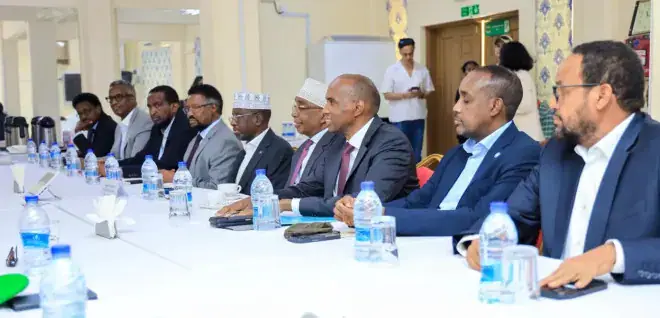
Senior Somali military and intelligence officials have held talks with opposition leaders in Mogadishu amid growing tensions over constitutional amendments and the electoral process. The discussions took place at the residence of former Prime Minister Mohamed Hussein Roble and were attended by National Intelligence and Security Agency Director Mahad Mohamed Salad, Somali National Army Commander Gen. Ibrahim Mohamed Mohamud, and Armed Forces Court Chairman Col. Hassan Ali Nur Shuute. Politicians affiliated with the Somali Future Council also attended the meeting.
The meeting focused on the country's security situation, political disagreements, and potential threats to national stability. Security officials shared concerns about alleged activities involving foreign actors that could threaten Somalia's security and stability. However, details of the suspected activities and evidence supporting the allegations were not disclosed. The discussions were seen as a potential effort to ease tensions and improve communication between the government and opposition amid continuing security challenges.
The Somali Future Council has called for an inclusive political agreement on the electoral process and warned against unilateral decisions that could deepen divisions among political stakeholders. The council's stance comes as tensions between President Hassan Sheikh Mohamud's administration and opposition groups continue over constitutional amendments, federal institution mandates, and arrangements for the country's next elections. The federal government has invited various stakeholders to a five-day consultative forum to discuss electoral arrangements.
The Nabad iyo Nolol party, associated with former President Farmaajo, has rejected reports suggesting it participated in a joint meeting with other opposition groups. Instead, senior military commanders visited Farmaajo separately at his residence to deliver a message from President Hassan Sheikh concerning the national consultative forum scheduled for November 14-18 in Mogadishu. The party emphasized the importance of an inclusive and mutually trustworthy process to achieve meaningful results.
Farmaajo had asked the commanders to convey his position that the planned consultations must be inclusive and based on mutual trust to achieve meaningful results. He also emphasized the importance of respecting earlier international mediation efforts and resuming negotiations from where they ended on September 3. This approach, according to Farmaajo, would improve the prospects of reaching an agreement acceptable to the country's political stakeholders.
The federal government has invited the Somali Future Council, Nabad iyo Nolol, the National Unity Forum, and civil society representatives to the consultative forum. The invitation follows opposition criticism of the electoral timetable announced in October, which schedules parliamentary elections for April 15, 2027, and a presidential election for May 15. Opposition groups have rejected the timetable, arguing it was announced without a broad political agreement.
The separate meetings with opposition figures come as political stakeholders consider whether to participate in the upcoming consultations and under what conditions. The outcome of these discussions and the participation of various stakeholders in the national forum will likely determine the trajectory of Somalia's electoral process and the country's future stability.
Key points
- Somali military and intelligence chiefs met with opposition leaders to discuss security and politics ahead of a national forum.
- The talks aimed to ease tensions and improve communication between the government and opposition amid electoral disagreements.
- The opposition has rejected the electoral timetable, citing a lack of broad political agreement.