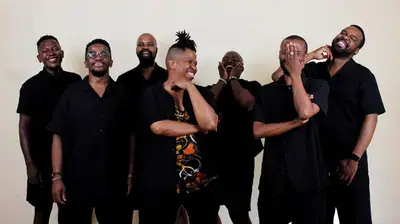
On the eve of local government elections in South Africa, Siyabonga Mthembu, frontman of The Brother Moves On, shared his thoughts on democracy, citizenship, and music. He believes that there is no such thing as apolitical music, citing amapiano as an example of highly politicized music. Mthembu argues that people often dismiss music as frivolous, but it can be a powerful tool for social commentary. His band's music often tackles complex issues, and he sees his role as naming what unnerves people and handing it back in a form that sparks conversation.
Mthembu's philosophy is reflected in his band's music, including their song "Good Times," which tells the story of a miner who celebrates his first pay check, only to be mugged. The song was inspired by a personal experience when Mthembu and his bandmates were mugged after a rehearsal. However, what stayed with him was not the violence but the response of the victims, who burst out laughing when the muggers approached two more men. This moment made Mthembu realize that people can come together and find humor in difficult situations, a quality he believes is essential to Ubuntu.
Mthembu is concerned that this sense of Ubuntu is disappearing, along with a larger sense of community. He fears that xenophobia and other social ills will continue to rise if people do not come together. Ahead of the local government elections, Mthembu is blunt about the state of democracy in South Africa, saying that it is broken and was never fixed. He places the blame not on politicians but on citizens who fail to hold them accountable. Mthembu believes that people uphold capitalism more quickly than they do democracy.
Mthembu's thoughts on democracy are also influenced by his 10-year-old daughter, who was born in the same year as South Africa's transition to democracy. He notes that it is unsettling to think that he was 10 in 1994, and now his daughter is 10 in a country that still struggles with many of the same issues. Mthembu believes that South Africans are stuck in a repetitive loop and wants people to think carefully about what they want the country to look like in 30 to 50 years.
As for the vote, Mthembu is undecided, saying that the choice is often about who not to vote for rather than who to vote for. He believes that a vote every five years is no substitute for real engagement and that citizens need to take responsibility for creating change. Mthembu sees his job on stage as naming what unnerves people and handing it back in a form that sparks conversation. He has spent months raising awareness about important issues at his shows.
Mthembu's outlook is what drew him to Ngeke!, a free, non-partisan festival at The Nest in Johannesburg, where The Brother Moves On will perform alongside other artists. The festival aims to promote accountability and spark conversation about important issues. Mthembu was drawn to the festival's complexity and its refusal to offer easy answers. He believes that art's job is not to give a perspective but to open up perspective and conversation.
Mthembu bristles at being called a protest band, saying that they are a band that plays issues. He believes that South Africa is a complex country that requires nuanced and thoughtful engagement. Mthembu's appetite for difficulty extends beyond festival bills, and he is willing to take on challenging topics and play in difficult contexts. The Brother Moves On will mark 13 years since the release of their debut album, A New Myth, with a concert at Untitled Basement in Braamfontein, Johannesburg.
Key points
- Siyabonga Mthembu believes that there is no such thing as apolitical music.
- Mthembu thinks that South Africa's democracy is broken and was never fixed.
- The Brother Moves On will perform at the anti-corruption festival Ngeke! in Johannesburg.