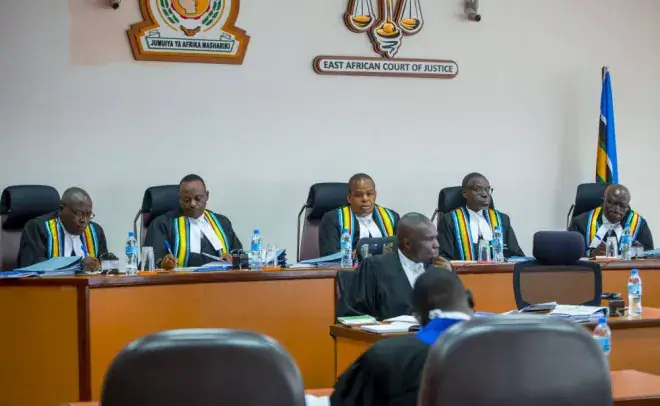
Six Somali Supreme Court judges, including Chief Justice Baashe Yusuf Ahmed, have filed a lawsuit against the federal government at the East African Court of Justice (EACJ) in Arusha, Tanzania. The judges are challenging actions taken by the government following President Hassan Sheikh Mohamud's decision to dismiss Baashe from his position as chief justice on November 4. The lawsuit, registered as Reference No. 69 of 2026, names the State Attorney General and the Federal Republic of Somalia as respondents.
The judges are seeking judicial examination of alleged interference with the Supreme Court's independence and disruption of its operations. They are also contesting the government's rejection of the Supreme Court's rulings on constitutional amendments extending presidential and parliamentary terms. On November 5, a five-judge panel ruled that the amendments could not be applied retroactively to current officeholders, declaring that Hassan Sheikh's presidential mandate expired on May 15, 2026.
The Supreme Court also declared Baashe's dismissal unconstitutional, arguing that the president lacked the authority to remove the chief justice unilaterally without following required constitutional procedures. However, the federal government rejected the rulings, maintaining that the constitutional amendments provide a legal basis for the current administration to remain in office until elections scheduled for 2027. Somalia's attorney general also challenged the Supreme Court's jurisdiction and questioned the legal standing of the proceedings.
The controversy has drawn international criticism, with United Nations human rights experts condemning Baashe's dismissal on November 12. The experts described the dismissal as interference with judicial independence and alleged that several Supreme Court judges had been deprived of their security protection and subjected to restrictions on their movements. They called for Baashe's reinstatement, the restoration of security arrangements for judges, and an end to actions undermining the independence of the judiciary.
The lawsuit marks the beginning of the formal response process and does not constitute a ruling on the legality of Baashe's dismissal or the Supreme Court's disputed constitutional decisions. The federal government has not publicly announced how it intends to respond to the regional court proceedings. Somalia became a full member of the East African Community in 2024, bringing it within the regional framework that includes the East African Court of Justice.
The case adds another legal dimension to Somalia's political crisis as disagreements continue over constitutional reforms, presidential and parliamentary mandates, and the timetable for national elections. The East African Court of Justice is responsible for interpreting and applying the East African Community Treaty and considering disputes falling within its jurisdiction. The six applicants are Baashe Yusuf Ahmed, Salah Sheikh Ibrahim Diblawe, Abdulkadir Idris Essa, Abubakar Ahmed Ali, Abdikafar Hussein Isak, and Abdiaziz Mohamed Yusuf.
The lawsuit follows a confrontation that began when Hassan Sheikh removed Baashe a day before the Supreme Court was scheduled to rule on the constitutionality of amendments extending presidential and parliamentary terms. On November 7, Hassan Sheikh presided over the swearing-in of Ibrahim Idle Suleiman as chief justice, further intensifying the dispute over the leadership of the country's highest judicial institution. The EACJ has given Somalia's attorney general 45 days from the date of service to respond to the case.
Key points
- The six judges are challenging the federal government's actions following President Hassan Sheikh Mohamud's decision to dismiss Chief Justice Baashe Yusuf Ahmed.
- The lawsuit has been registered as Reference No. 69 of 2026 at the East African Court of Justice in Arusha, Tanzania.
- The controversy has drawn international criticism, with UN human rights experts condemning Baashe's dismissal as interference with judicial independence.