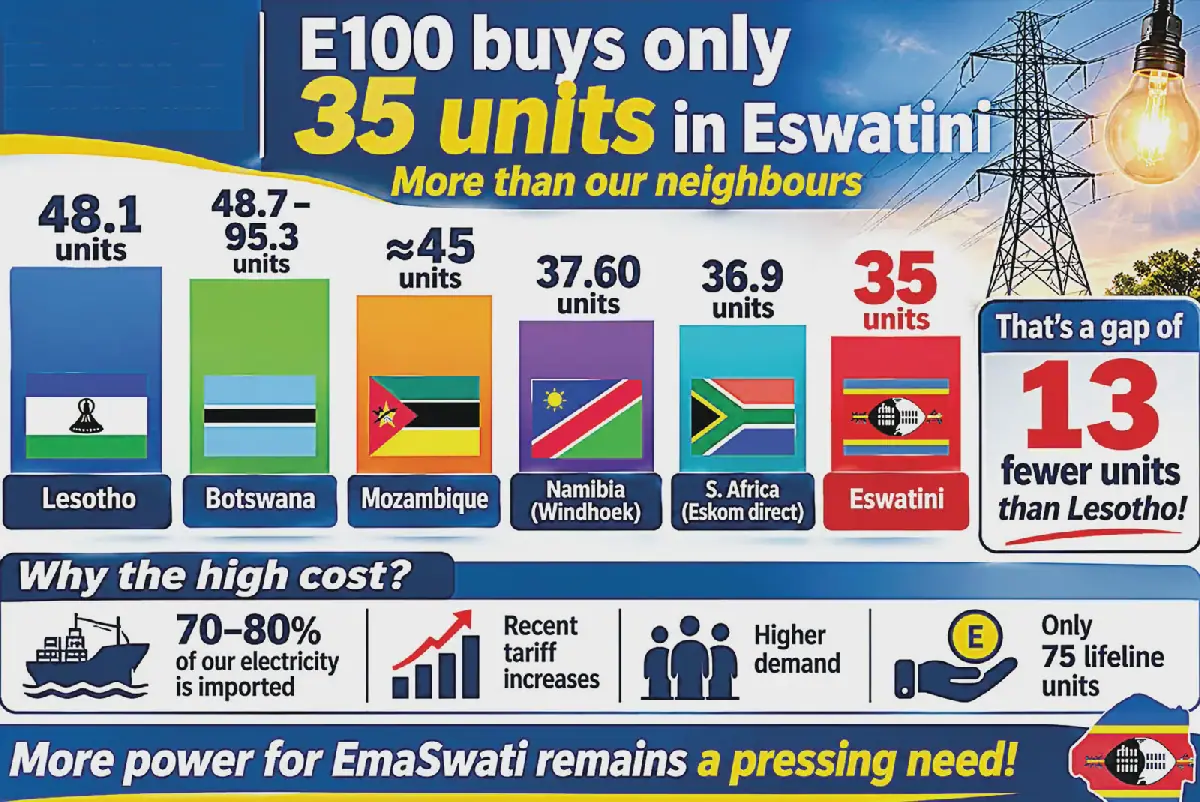
A recent review of 2026 prepaid tariffs in the Southern African Customs Union (SACU) countries reveals that Eswatini residents pay more for electricity than their counterparts in other member states. The comparison, which includes South Africa, Botswana, Lesotho, Namibia, and Eswatini, shows that E100 buys fewer units of electricity in Eswatini than in almost any neighboring country. Mozambique, a non-SACU member, was also included in the study to provide a regional perspective.
The study used a standard shopping basket of E100 worth of prepaid electricity in each country. The results show that E100 buys between 24 and 48 units of residential prepaid electricity across South Africa, Lesotho, Namibia, and Mozambique. In South Africa, the number of units purchased depends on whether the buyer purchases directly from Eskom or through a municipality and on how much power they have already bought in that month. Buying directly from Eskom on the ‘Homelight’ prepaid tariff gives roughly 36.9 units for R100.
Lesotho offers the most favorable electricity prices, with E100 buying about 48.1 units of electricity at the standard domestic tariff of M2.08 per unit. Poor households that qualify for the subsidized lifeline rate of M0.93 per unit receive more than 100 units for the same M100. The Lesotho Electricity and Water Authority (LEWA) attributes the low prices to the country's ability to generate about 60% of its own electricity at home, mainly through the 75MW ‘Muela hydropower station.
Namibia sits in the middle of the table, with E100 buying 37.60 units in the City of Windhoek, 36.35 units in the northern regions served by NORED, and 31.11 units on the coast under Erongo RED. The number of units a buyer receives in Namibia depends on the regional electricity distributor or the municipality that sells the power.
Botswana offers more favorable electricity prices than Eswatini, with E100 buying between 48.7 and 95.3 units of domestic prepaid power, depending on how much electricity a household has already bought in that month. The Botswana Energy Regulatory Authority (BERA) approved a 9% increase in tariffs that took effect on August 1, 2026.
In contrast, Eswatini residents face higher electricity prices, with E100 buying fewer units than in other SACU countries. The reasons behind the high prices in Eswatini are not explicitly stated, but the country's reliance on imported electricity may contribute to the higher costs.
The disparity in electricity prices across SACU countries highlights the need for a more comprehensive regional approach to energy pricing and generation. As the region continues to develop and grow, it is essential to address the differences in electricity costs to ensure that residents have access to affordable and reliable energy.
Key points
- Eswatini residents pay more for electricity than their counterparts in other SACU countries.
- Lesotho offers the most favorable electricity prices in the region.
- The disparity in electricity prices across SACU countries highlights the need for a more comprehensive regional approach to energy pricing and generation.
Reporting sources
- EmaSwati pay more on electricity than SACU counterparts · Times of Swaziland