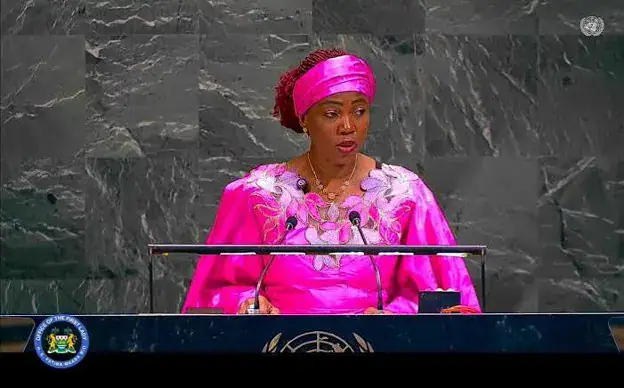
Sierra Leone's First Lady Fatima Maada Bio has taken her campaign against child marriage from Sierra Leone to the global stage. Her efforts have led to a landmark UN resolution establishing November 27 as an international day against child, early and forced marriage. Bio's personal experience with child marriage has driven her advocacy. She says she was a child whose future was being decided by adults, with marriage being chosen for her. Bio refused that future, but acknowledges not every girl has that choice.
The UN's decision to establish an international day against child marriage is a significant diplomatic achievement. Sierra Leone introduced the resolution, which was co-sponsored by dozens of UN member states. The new observance aims to raise awareness, strengthen political commitment, and accelerate efforts to end child, early and forced marriage. Bio's campaign, Hands Off Our Girls, has made protecting girls a central part of her public advocacy. Her message is clear: child marriage is not culture, it is a crime.
Child marriage is a global crisis affecting millions of girls. According to UNICEF, 650 million women and girls alive today were married before their 18th birthday. In sub-Saharan Africa, about 35 percent of young women are married before 18. The consequences of child marriage can extend across a girl's life, including interrupted education, early pregnancy, and social isolation. UNICEF describes child marriage as a fundamental violation of human rights.
In Sierra Leone, progress has been made in reducing child marriage. According to UNICEF's 2025 country profile, 30 percent of women aged 20 to 24 were married before the age of 18, down from 51 percent in 1994. However, almost one in three young women in the country still experienced marriage before adulthood. Traditional and religious norms, economic vulnerability, and social pressures continue to complicate efforts to eliminate child marriage.
Bio's argument places child marriage within a broader human-rights debate. She argues that cultural or traditional practices cannot justify denying children rights guaranteed under national and international law. Sierra Leone has a history of confronting forced marriage through international criminal law. The Special Court for Sierra Leone outlawed forced marriage, recognising it as an "other inhumane act" constituting a crime against humanity.
The adoption of the international day against child marriage was celebrated by campaigners and diplomats. However, the new date on the UN calendar cannot, by itself, prevent child marriage. Bio acknowledged that in her remarks to the General Assembly, arguing that political attention, strong laws, and sustained political will are also necessary. The international day provides a platform for governments, international organisations, and civil society to raise awareness and accelerate efforts to end child marriage.
The campaign to end child marriage is ongoing. Bio's efforts have made a significant impact, but much work remains to be done. The international day against child marriage will provide an annual platform for campaigners and governments to raise awareness and push for change. Key to the campaign's success will be sustained political will, strong laws, and effective institutions.
Key points
- The UN has established November 27 as an international day against child, early and forced marriage.
- Sierra Leone's First Lady Fatima Maada Bio has led the global campaign to end child marriage.
- Child marriage affects 650 million women and girls worldwide, with 35 percent of young women in sub-Saharan Africa married before 18.
Reporting sources
- The Girl Who Escaped Child Marriage Is Now Asking the World to End It · Pan African Visions