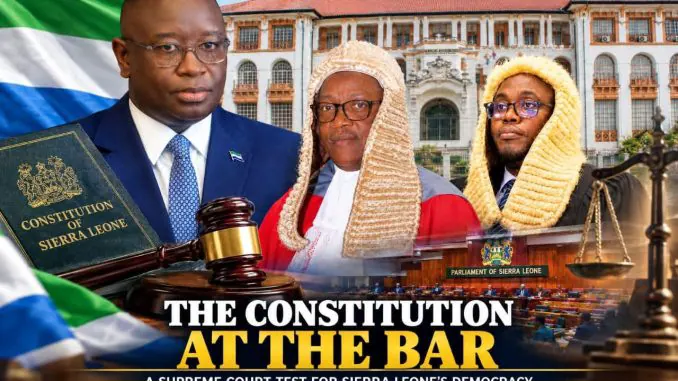
The constitutional amendment dispute in Sierra Leone has reached the Supreme Court, with the court's decision set to determine whether Parliament followed the required procedure to change the Constitution. The dispute centers on the interpretation of Section 91(1) and Section 108(2)(b) of the Constitution, which relate to the voting requirements for decisions and constitutional amendments. The Speaker of Parliament and President Julius Maada Bio have sought the court's guidance on the matter.
The Constitution of Sierra Leone (Amendment) Bill, 2025, has been at the center of the dispute, with the opposition arguing that the bill was passed without the required two-thirds majority of Members of Parliament. The bill proposes to modify sections 85 and 87 of the Constitution. The Speaker classified the Bill under the ordinary majority rule, while the opposition argues for a higher threshold required for constitutional amendments.
The key issue in the dispute is the interpretation of the term "two-thirds of the Members of Parliament," which is not clearly defined in the Constitution. The opposition walked out of Parliament during the vote, leaving 96 Members voting in favor of the amendments. If the full membership of 149 Members is considered, 96 votes fall short of two-thirds. However, if the count is based on those present, the situation changes.
The Supreme Court's decision will have far-reaching implications for Sierra Leone's democracy and constitutional governance. The court's role is to focus on the legal procedures, not to judge the political merits of the proposed reforms. The court's ruling will establish guiding rules for Parliament beyond the current situation and provide clarity on the constitutional requirements for amendments.
President Bio has emphasized the need for procedural integrity in constitutional and electoral reforms, linking them to broader governance goals. The opposition has argued that the bill was passed without following the established rules, while the government has maintained that the amendments are necessary for the country's development.
The Supreme Court's decision will depend on its interpretation of the constitutional text, rather than political expectations. The court's conclusions will endure beyond the current debate, as the procedural rules apply to all future governments. A Constitution is strongest when those in power adhere to the laws that grant them that power.
The court's ruling is expected to provide clarity on whether Section 108(2)(b) provides a distinct binding threshold separate from Section 91(1), what "Members of Parliament" includes, and how this applies to the vote on the Bill. The court's decision will determine whether Sierra Leone can amend its Constitution without following the established rules.
Key points
- The Supreme Court will decide on the interpretation of Section 91(1) and Section 108(2)(b) of the Constitution.
- The court's decision will determine the validity of the Constitution of Sierra Leone (Amendment) Bill, 2025.
- The ruling will establish guiding rules for Parliament and provide clarity on the constitutional requirements for amendments.