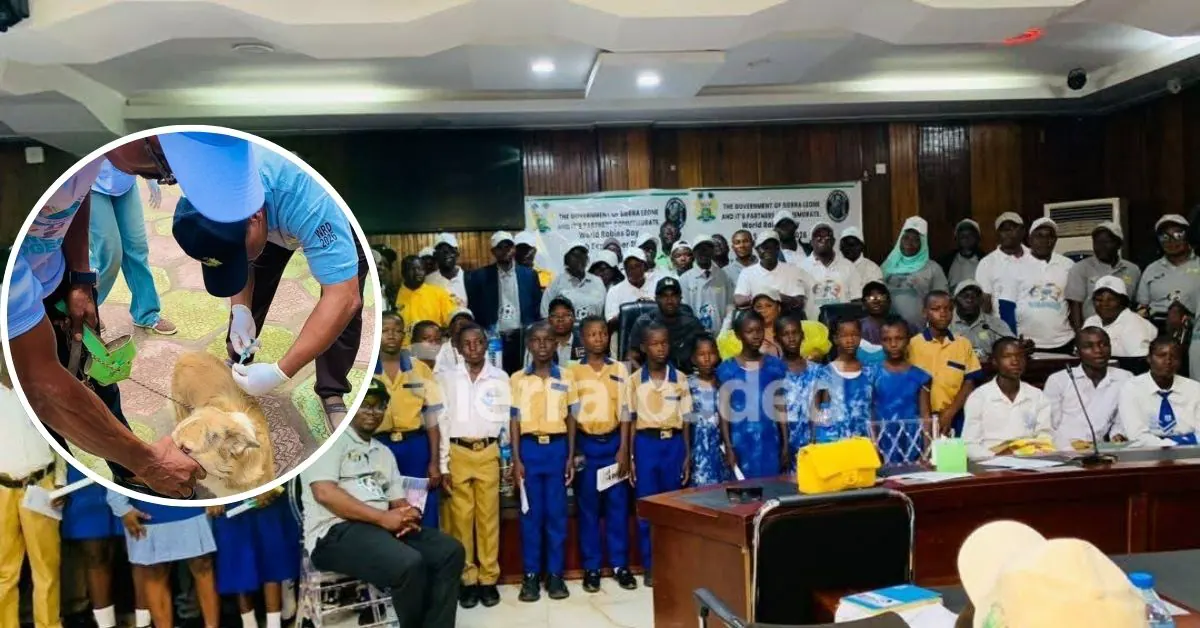
The Ministry of Agriculture and Food Security, in collaboration with key partners, has pledged to eliminate human deaths from dog-mediated rabies by 2030. This commitment was made during the 2026 World Rabies Day commemoration held in Bo Town. The Deputy Minister II of Agriculture and Food Security, Ing. Bryan Smart-Kanu, emphasized the government's determination to tackle rabies under the One Health approach, which is aligned with the Feed Salone agenda.
Rabies remains almost always fatal once clinical symptoms appear, but it is entirely preventable through timely vaccination and proper post-exposure care. Ing. Bryan Smart-Kanu outlined ongoing government interventions, including expanded mass dog vaccination campaigns, strengthened veterinary and surveillance systems, and improved coordination across human and animal health sectors. He stressed that success depends on shared responsibility, urging pet owners to ensure routine vaccination of dogs and cats.
The Director of Livestock and Veterinary Services, Mr. Saidu Bamayange, highlighted the broader ecological risks associated with rabies transmission. He noted that environmental degradation and encroachment into wildlife habitats are increasing human–animal interactions. Mr. Bamayange called for stronger surveillance systems, particularly in forest-edge communities, and emphasized responsible animal ownership as a key preventive measure.
According to Assistant Director of Livestock and ISAVET National Coordinator, Mr. Salam Saidu, Bombali District has reported a concerning rise in dog bite incidents and suspected rabies cases. The district recorded 383 dog bite cases between Week 1 and 38 in 2025, which increased to 469 cases in the same period in 2026. Additionally, 12 suspected rabies-related deaths were recorded in the district between January and August 2026.
The situation in Bombali District has been described as alarming, with a call for urgent improvements in data sharing and coordination between animal and human health authorities. Stakeholders present at the event, including representatives from the National Public Health Agency and the Ministry of Environment and Climate Change, reaffirmed support for efforts to make rabies a disease of the past in Sierra Leone.
The Ministry of Agriculture and Food Security is working with partners, including Population Services International (PSI), to achieve its goal of eliminating rabies deaths by 2030. The event, attended by students, teachers, and other partners in Bo District, aimed to raise awareness about the risks of rabies and the importance of collaboration in preventing its transmission.
The government's efforts to eliminate rabies deaths by 2030 are aligned with its broader goal of improving animal and human health in Sierra Leone. Key to this effort is the participation of pet owners, who must ensure routine vaccination of their animals and seek immediate medical attention for bite victims.
Key points
- The Ministry of Agriculture and Food Security aims to eliminate human deaths from dog-mediated rabies by 2030.
- The government is implementing interventions, including mass dog vaccination campaigns and strengthened veterinary and surveillance systems.
- The situation in Bombali District is alarming, with a significant increase in dog bite incidents and suspected rabies cases.