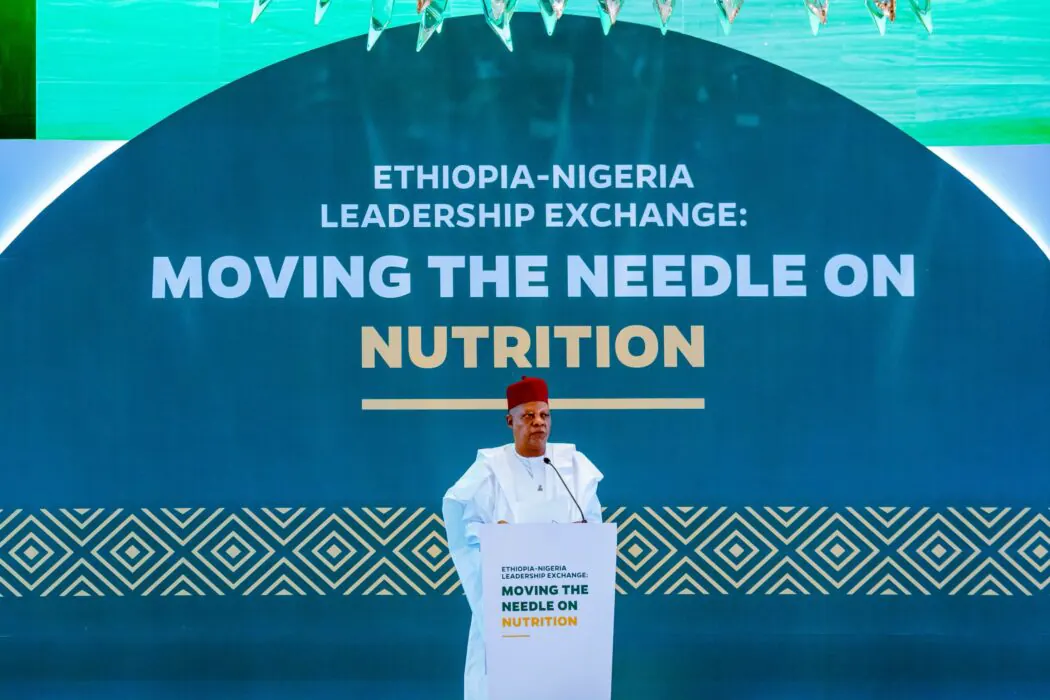
Nigeria's Vice President Kashim Shettima has announced plans to accelerate work on a National Food and Nutrition Bill to protect nutrition financing, strengthen accountability, and sustain interventions across successive administrations. The proposed legislation aims to strengthen the federal government's Nutrition 774 Initiative, which brings together all tiers of government to tackle malnutrition. This move is part of Nigeria's efforts to address the country's high malnutrition rates.
The Nigeria-Ethiopia Nutrition Leadership Exchange Forum in Addis Ababa, Ethiopia, provided the platform for Vice President Shettima to make this announcement. The forum was attended by high-ranking officials, including governors of Jigawa, Zamfara, Osun, and Abia states, as well as ministers of health, agriculture, budget, and education. The Nigerian delegation also included the Director-General of the National Emergency Management Agency and the Executive Director of the National Primary Health Care Development Agency.
According to Vice President Shettima, Nigeria's National Policy on Food and Nutrition 2026–2035 sets ambitious targets to reduce the country's stunting rate. The targets include reducing the stunting rate to 32 per cent by 2029, 28 per cent by 2032, and 25 per cent by 2035. To achieve these targets, the federal government is working with states and local governments to strengthen nutrition committees and delivery capacity across all levels of government.
Vice President Shettima noted that nutrition committees have already been established in 32 State Houses of Assembly, while over 450 local governments have also established similar committees. He believes that with these committees in place, the time is ripe to give the country's nutrition response stronger legislative backing. The proposed National Food and Nutrition Bill aims to provide this backing and ensure that nutrition financing is protected and accountability is enforced.
The Vice President disclosed that the Nutrition 774 Initiative provides a single framework for all tiers of government to work together to tackle malnutrition. Under this initiative, governors and local government chairpersons are expected to lead implementation within their respective jurisdictions. The federal government is working with states on costed plans for priority councils, bringing together health, agriculture, and social protection sectors.
The National Food and Nutrition Bill is expected to deepen a compact among federal, state, and local governments to deliver a unified response to malnutrition, beginning at the community level. This compact aims to ensure that all levels of government work together to address the country's high malnutrition rates. The bill will also help to ensure that nutrition interventions are sustained across successive administrations.
Key stakeholders who attended the forum include the Coordinating Minister of Health and Social Welfare, Prof. Muhammad Ali Pate, and the Minister of Agriculture and Food Security, Senator Abubakar Kyari. Others include the Minister of Budget and Economic Planning, Senator Abubakar Atiku Bagudu, and the National President of the Association of Local Governments of Nigeria, Hon. (Engr.) Bello Lawal. The forum provided a platform for these stakeholders to discuss ways to address malnutrition in Nigeria.
Key points
- Nigeria aims to reduce its stunting rate to 25 per cent by 2035.
- The proposed National Food and Nutrition Bill aims to strengthen the federal government's Nutrition 774 Initiative.
- Nutrition committees have been established in 32 State Houses of Assembly and over 450 local governments.