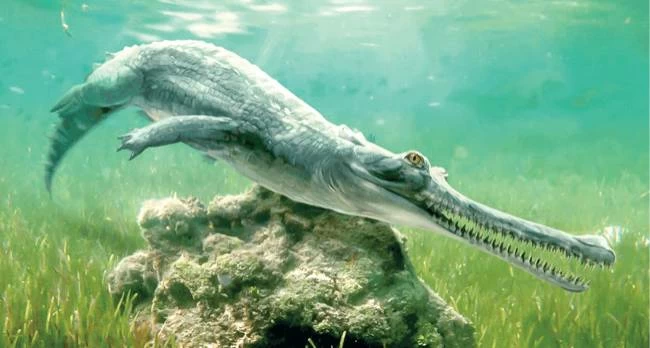
A team of researchers from the Vertebrate Paleontology Center at Mansoura University has made a groundbreaking discovery, identifying a new species of ancient crocodile. The discovery was made by re-examining a historical Egyptian fossil found in the Gebel Qattam region in 1927. Using modern scientific tools, the team conducted anatomical and evolutionary studies, revealing previously unknown characteristics of the species.
The fossil, now named "Hierogavialis kyrinensis," dates back to the middle Eocene era, approximately 45 million years ago. During this time, Egypt had shallow and warm marine environments, home to various creatures, including whales, sea cows, and long-snouted crocodiles. The discovery provides valuable insights into the evolution of crocodiles in Egypt and North Africa.
The research team, led by Dr. Hisham Salam, included scientists from the Mansoura University Vertebrate Paleontology Center and other international researchers. They examined the internal structure of the fossil's skull and digitally reconstructed it. The study, published in a scientific journal, highlights the significance of re-examining historical fossils using modern techniques.
The newly discovered species, "Hierogavialis kyrinensis," has distinct anatomical features, including a long snout that makes up about 64% of the skull's length. The fossil's unique characteristics were found in the eye socket and other parts of the skull. The name "Hierogavialis" is derived from the Egyptian god Horus and the Greek word "gavialis," referring to the Indian gharial.
The discovery was made possible through collaboration with the Stuttgart State Museum of Natural History in Germany, where the fossil is currently housed. The research contributes to a better understanding of the evolutionary history of crocodiles and their relationships with other species. The study's findings have significant implications for the field of paleontology.
Dr. Sara Saber, a researcher involved in the study, emphasized that the discovery highlights the importance of re-examining historical fossils using modern techniques. The study demonstrates that even well-known fossils can yield new information with advancements in technology and analytical methods.
The Vertebrate Paleontology Center at Mansoura University has initiated a project to study Egyptian fossils preserved in foreign museums, promoting international collaboration and the sharing of knowledge. The discovery of "Hierogavialis kyrinensis" is a significant addition to the field of paleontology, providing new insights into the evolution of crocodiles and their history in Egypt.
Key points
- The discovery of a new species of ancient crocodile, "Hierogavialis kyrinensis," sheds light on the evolution of these creatures 45 million years ago in Egypt.