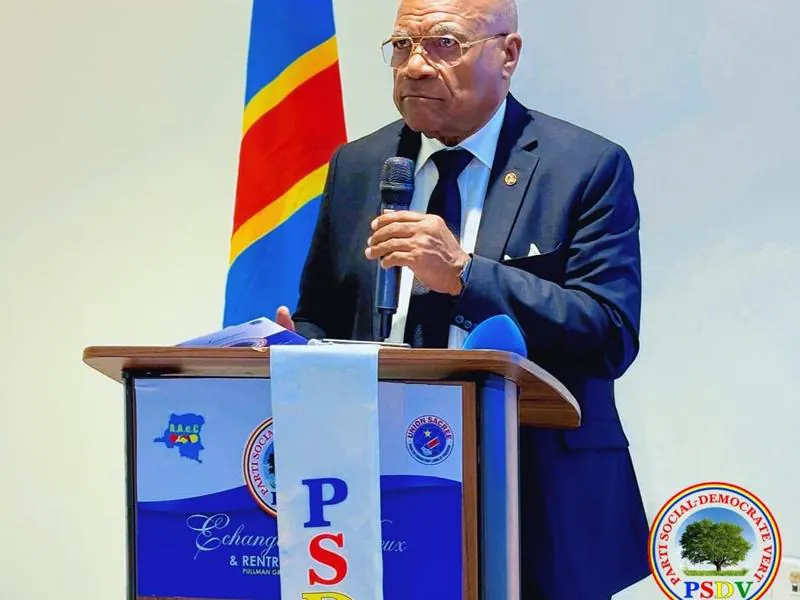
Former DRC Foreign Minister Léonard She Okitundu has revealed his role in discussions between the Union for Democracy and Social Progress (UDPS) and the Common Front for Congo (FCC), which led to the formation of the current coalition government. In a recent interview, She Okitundu claimed he was one of the key individuals who initiated talks between the two parties. These discussions took place in Ibiza and later in Venice, with She Okitundu personally attending the meetings.
She Okitundu emphasized that the talks aimed to bring together the ruling party and the opposition, particularly the UDPS. He noted that the UDPS had chosen Samy Badibanga and Bruno Tshibala as prime ministers, but these individuals lacked the trust of their party. According to She Okitundu, this weakness led to the decision to engage with Félix Tshisekedi, who was then the UDPS's external relations officer and had gained the party's trust.
She Okitundu stated that Tshisekedi was kept informed of the discussions through two intermediaries. He justified the engagement with Tshisekedi by highlighting the ideological similarities between the UDPS and the FCC, both claiming to represent social democracy. She Okitundu argued that the tensions between the parties were primarily due to personal conflicts and egos, which needed to be set aside.
The former minister denied allegations that the FCC had offered the prime minister position to the UDPS in exchange for accepting a delay in the electoral calendar. Instead, She Okitundu explained that the elections required preparation and that the ruling party could not manage this process alone. He emphasized the need to involve the opposition, particularly the UDPS, in the process.
She Okitundu attributed the failure of the Ibiza and Venice talks to internal divisions within the UDPS. He claimed that some members supported Tshisekedi, while others had different views. She Okitundu stated that he had advocated for engaging with Tshisekedi, whom he considered the legitimate representative of the UDPS.
She Okitundu clarified that his involvement in the talks ended with the initial rapprochement between the parties. He asserted that he had not played a role in the subsequent management of the CACH-FCC coalition, instead becoming a simple parliamentarian. His comments provide insight into the complex negotiations that led to the current coalition government in the DRC.
The discussions between the UDPS and FCC ultimately led to the formation of the CACH-FCC coalition, with Félix Tshisekedi emerging as a key figure. She Okitundu's account highlights the importance of building trust and legitimacy in negotiations between rival parties. His revelations offer a unique perspective on the country's recent political history.
Key points
- She Okitundu played a key role in initiating talks between the UDPS and FCC.
- The talks ultimately led to the formation of the CACH-FCC coalition.
- She Okitundu emphasized the importance of engaging with Félix Tshisekedi, considered the legitimate representative of the UDPS.