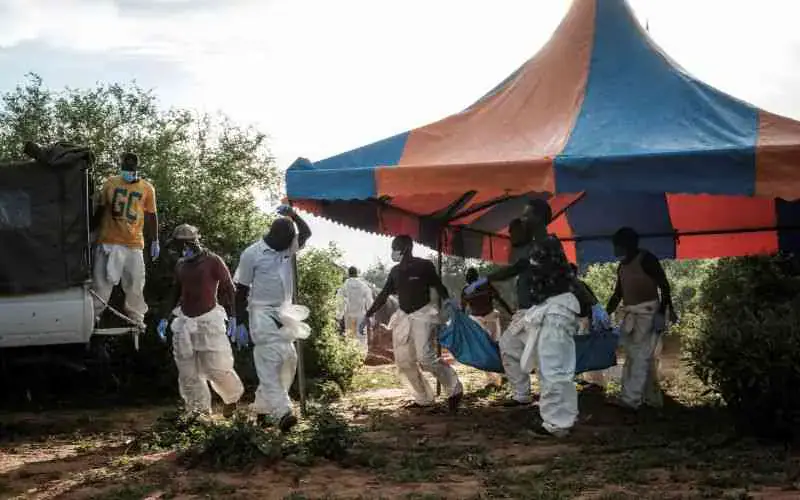
The discovery of hundreds of bodies in Kenya's Shakahola forest in 2023 highlighted the devastating consequences of religious extremism. However, this tragedy was not an isolated incident. For decades, various parts of the world have witnessed the emergence of religious movements built around unquestionable loyalty to charismatic leaders, extreme teachings, and apocalyptic prophecies. These movements have left behind deaths, broken families, and questions about the limits of religious freedom.
In Kenya, a disturbing case emerged in Maella, Naivasha, where a controversial religious group known as Kanitha wa Ngai, or Church of God, was accused of exposing children to preventable deaths. The group refused conventional medical treatment, leading to the deaths of four minors. Authorities ordered the closure of the church in December 2023, and police rescued four ailing children while arresting suspects over alleged neglect. The church's leader was reported to have fled the area.
Uganda experienced one of Africa's deadliest religious disasters in 2000. A breakaway Catholic sect, founded by Joseph Kibweteere and Credonia Mwerinde, preached strict adherence to the Ten Commandments and warned of an impending apocalypse. When their prophecy failed to materialize on December 31, 1999, followers began to revolt. On March 17, 2000, the leaders boarded up the church, trapped hundreds of followers inside, and set it on fire. Police investigations uncovered hundreds more bodies poisoned or stabbed in mass graves.
The US has also experienced devastating cult-related tragedies. In 1978, more than 900 people died at Jonestown, Guyana, after Peoples Temple leader Jim Jones orchestrated a mass murder-suicide. In 1997, Heaven's Gate made international headlines when 39 members died in a mass suicide, believing that abandoning their earthly bodies would allow them to join an extraterrestrial spacecraft.
The Order of the Solar Temple, founded in 1984 by Joseph Di Mambro and Luc Jouret, was an elite doomsday cult that attracted wealthy professionals. The leaders taught that Earth was facing an imminent ecological collapse and that followers needed to undergo a "transit" to escape the apocalypse. Between 1994 and 1997, the cult's leadership triggered a series of highly orchestrated mass murders and suicides in Switzerland, Canada, and France, resulting in 74 deaths.
These incidents reveal a recurring pattern: the concentration of power around charismatic leaders, the isolation of followers, the suppression of independent thinking, and the manipulation of religious beliefs. The consequences expose the vulnerability of people drawn into movements that demand absolute obedience. For Kenya, the lessons from Shakahola and the earlier Naivasha case raise difficult questions about the registration, monitoring, and accountability of religious institutions.
The Kenyan government and citizens must consider the risks associated with extremist religious teachings and take steps to prevent similar tragedies. The international community can also learn from these incidents, recognizing the warning signs of cult-like behavior and taking proactive measures to protect vulnerable individuals. By understanding the complexities of these movements, we can work towards creating a safer and more informed society.
Key points
- Concentration of power around charismatic leaders contributes to deadly outcomes
- Isolation of followers and suppression of independent thinking exacerbate vulnerability
- Manipulation of religious beliefs can have devastating consequences