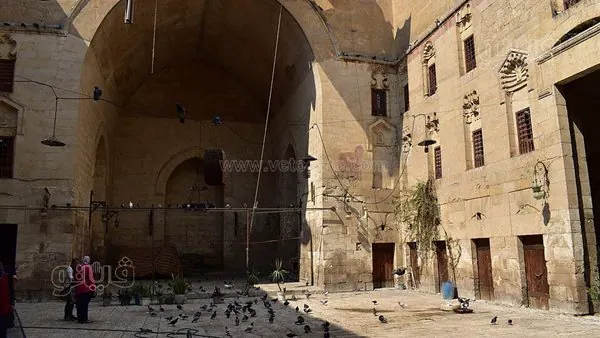
In the heart of Cairo's Gamaliya neighborhood, a historic site stands as a testament to the city's rich history. The Khanqah of Baybars al-Jashnkir, built in the 14th century, has been a monastery, a mosque, and a madrasa, but its current state is a far cry from its former glory. The complex, with its stone façade, dome, and minaret, showcases Mamluk architecture, but its interior is cluttered and worn. The site has been neglected for centuries, and its current state reflects the city's struggles with preserving its historic heritage.
The Khanqah was built in 1306 by Baybars al-Jashnkir, a high-ranking official in the Mamluk state, who later became Sultan. The site was constructed on part of the Fatimid Dar al-Wizara, a government building from the 10th century. The complex was designed to accommodate Sufi devotees, providing them with living quarters, food, and educational activities. The site's architecture reflects its purpose, with a large courtyard, iwans, and a mosque.
One of the most striking features of the Khanqah is its entrance, which includes a reused stone block from the 12th century BC, featuring hieroglyphics and images of Pharaoh Ramses IX. This blend of ancient and Mamluk-era architecture is a testament to Cairo's rich history and the city's tendency to build upon and reuse existing structures. The entrance also features intricate marble carvings and a copper-covered door.
The Khanqah's history is complex, with periods of use and neglect. After Baybars' death, the site was abandoned and his name was erased from some records. It was later restored and continued to function as a Sufi monastery and mosque. Over the centuries, Cairo has undergone significant changes, and the Khanqah has been adapted and repurposed. Today, the site is home to a mix of historical and modern elements, including a group of homeless people and street children who have made the site their home.
The current state of the Khanqah is a reflection of Cairo's broader challenges in preserving its historic heritage. The site requires significant restoration and maintenance, but its preservation is also tied to the social and economic issues affecting the surrounding neighborhood. The presence of homeless people and street children at the site highlights the need for a comprehensive approach to addressing the city's social and economic challenges.
The Khanqah's minaret and dome are notable features of the site's architecture. The minaret is short and wide, with a distinctive shape, while the dome covers Baybars' tomb. The site's design reflects the Mamluk tradition of combining religious and funerary functions. Despite its historical significance, the Khanqah is not well-maintained, and its preservation requires urgent attention.
The Khanqah of Baybars al-Jashnkir is a microcosm of Cairo's history and a symbol of the city's struggle to preserve its heritage. The site has been a monastery, mosque, and madrasa, and its current state reflects the city's complex social and economic challenges. As Cairo continues to grow and evolve, it is essential to find a balance between preserving the city's historic heritage and addressing the needs of its residents.
Key points
- The Khanqah of Baybars al-Jashnkir is a historic site in Cairo that requires preservation and restoration.
- The site's current state reflects Cairo's broader challenges in preserving its historic heritage.
- The preservation of the Khanqah is tied to the social and economic issues affecting the surrounding neighborhood.