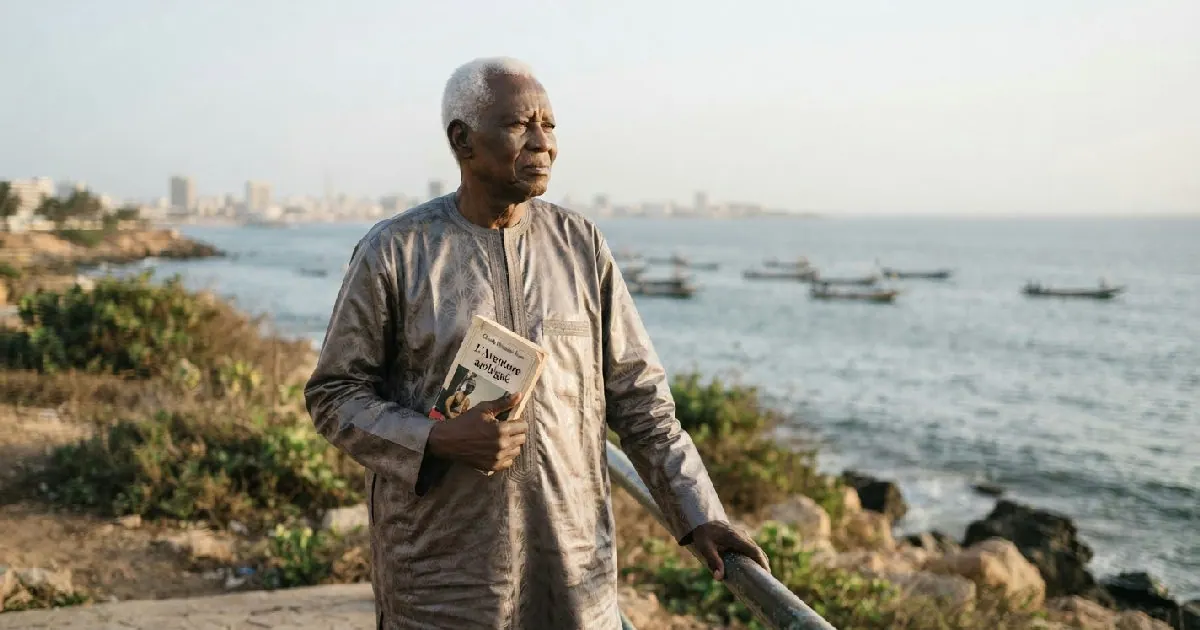
Cheikh Hamidou Kane, a renowned Senegalese writer and statesman, passed away on October 3, 2026, in Dakar at the age of 98. Kane was best known for his 1961 debut novel, "Ambiguous Adventure," a philosophical exploration of faith and modernity that was banned in Senegal. The novel asked a profound question: how could one embrace global knowledge without losing one's fundamental self? This intellectual tension defined not only his literary output but also his personal journey and public service.
Born in Matam, northern Senegal, in 1928, Kane's upbringing presented a unique blend of traditional and Western influences. He came from a prominent family of Fulani chiefs and Muslim scholars, immersed in Qur'anic teachings. Yet, he also navigated the French colonial school system from the age of ten, experiencing firsthand the clash of cultures he would later articulate so powerfully. This early duality profoundly shaped Kane's worldview, mirroring broader societal debates across colonial West Africa.
Kane's academic path led him to Paris, where he studied law and philosophy at the prestigious Sorbonne. He also earned degrees from the École Nationale de la France d'Outre-Mer, an institution designed to train administrators for French colonial territories. These experiences provided Kane with a critical foundation for his future roles as a thinker and public servant, exposing him to both Western intellectual traditions and the machinery of colonial governance.
After gaining crucial insights in France, Kane returned to Senegal before independence, ready to contribute to the nascent nation. He embarked on a distinguished career in public service, holding various high-level government positions. His work sought to operationalize the very questions his novel explored about national development and cultural integrity. He served under both President Léopold Sédar Senghor and President Abdou Diouf, becoming Governor of the Thiès region in 1961 and later High Commissioner General for Planning in 1962.
Kane's most celebrated novel, "L'Aventure ambiguë," quickly became a classic of African literature, exploring the profound clash between traditional African culture and Western civilization. The novel follows Samba Diallo, a young Senegalese Muslim whose education journey takes him from a deeply spiritual upbringing to French schooling and eventually to Paris. The narrative vividly portrays the cultural displacement and "ambiguous journey" faced by many Africans of his generation.
Kane's work brilliantly underscored that learning new things often changes how we understand what we already know. He offered no simple choices between Africa and Europe, or between tradition and modernity. Instead, he left readers with the enduring power of ambiguity, reflecting the complex realities of African nation-building and the search for a distinct identity. His philosophical contributions continue to shape discourse on education and cultural preservation in Africa.
Senegalese President Bassirou Diomaye Faye lauded Kane for articulating the enduring question of "opening ourselves to the world's knowledge without losing who we are." This testament highlights the lasting relevance of Kane's central theme. Indeed, his intellectual legacy received formal recognition when the Digital University of Senegal was renamed the Université Numérique Cheikh Hamidou Kane in 2023, underscoring how his exploration of cultural negotiation remains a guiding principle for navigating contemporary challenges.
Key points
- Cheikh Hamidou Kane's literary and philosophical contributions continue to shape African identity and discourse on education and cultural preservation.
- Kane's novel "L'Aventure ambiguë" remains a foundational text in African thought, exploring the complexities of cultural negotiation and identity.
- Kane's legacy serves as a timeless lesson for Nigeria and the broader African continent, highlighting the importance of integrating external influences thoughtfully while guarding one's core identity and cultural integrity.