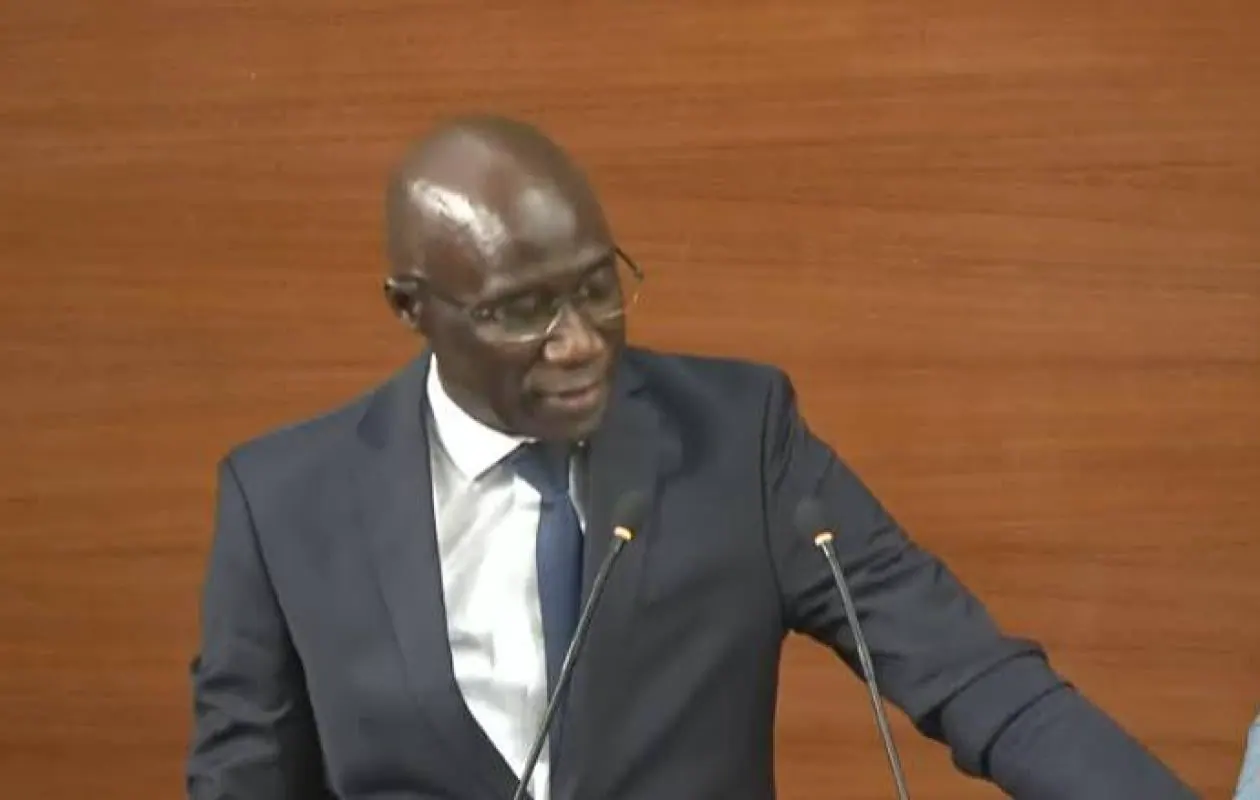
The Senegalese government has announced its intention to challenge a newly adopted law regulating special credits in the Constitutional Council. The law, which was passed by the National Assembly on October 1, 2026, aims to strengthen parliamentary oversight of special funds. The Minister of Justice, Me Moussa Sarr, stated that the government will refer the law to the Constitutional Council as soon as it is received.
The law, proposed by the parliamentary majority, modifies the organic law on finance laws to enhance oversight and control of special credits or funds. The government had submitted three amendments to the bill, two of which aimed to remove specific mentions of special credits and revise the parliamentary control mechanism. However, these amendments were rejected by parliamentarians, who ultimately adopted the bill with 132 votes, including 127 in favor and five abstentions.
The government's decision to challenge the law is based on concerns over the regularity of the parliamentary procedure and the conformity of the text with the Constitution and community commitments. The government had requested a blocked vote on the bill, citing the need to ensure the legal coherence of the device and the effectiveness of state action. However, this request was rejected by parliamentarians, who opted for a more restricted parliamentary control mechanism.
The Constitutional Council had previously ruled in July 2026 that the refusal of the Assembly to proceed with a blocked vote requested by the government constituted a violation of the Constitution. The government is relying on this jurisprudence to challenge the approach of parliamentarians. The law maintains the main provisions adopted in committee, including the explicit inscription of special funds in budgetary allocations.
The adoption of the law marks a significant development in the institutional tug-of-war over the regulation of special credits in Senegal. The government had expressed concerns over the potential overlap with the competences of the Court of Auditors and the need to preserve coherence with the UEMOA community directive. The Constitutional Council's review will likely provide clarity on the constitutionality of the law and its implications for parliamentary oversight.
The Minister of Justice, Me Moussa Sarr, had argued that the blocked vote was necessary to ensure the effectiveness of state action and the coherence of the legal framework. The rejection of this request by parliamentarians has been seen as a significant setback for the government. The referral of the law to the Constitutional Council is expected to further escalate tensions between the executive and legislative branches.
The Constitutional Council's review of the law will be closely watched by stakeholders in Senegal, who are keen to understand the implications of the law on parliamentary oversight and the regulation of special credits. The Council's decision is expected to have significant implications for the country's governance and institutional framework.
Key points
- The Senegalese government plans to challenge a new law regulating special credits in the Constitutional Council over concerns about its constitutionality and regularity.