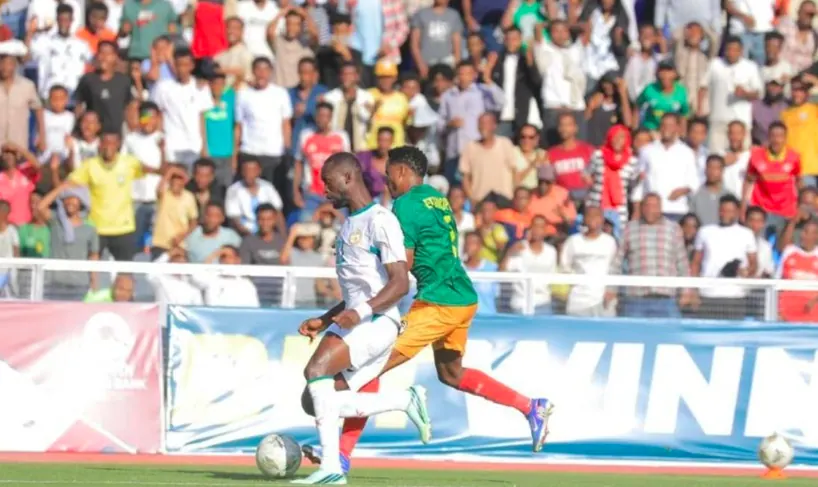
Senegal's national football team, the Lions, recently faced Ethiopia in an international match. The team's coaching staff had decided to switch to a three-man defense, which was expected to provide more density and offensive freedom. However, the experiment backfired, particularly due to the presence of two left-footed defenders, Moussa Niakhaté and Malang Sarr, in the defense.
The main issue arose from Niakhaté's positioning on the right side of the three-man defense. As a left-footed player, he was forced to make passes with his weaker foot, leading to slow and predictable play. This resulted in the Ethiopian team having ample time to adjust their defense, ultimately neutralizing the Lions' offensive threat.
The problem was not limited to Niakhaté's foot preference. The presence of two left-footed defenders in the same defensive unit caused confusion and congestion in certain areas of the field. Both players are accustomed to playing on the left side of the defense, which led to a lack of clarity in their positioning and decision-making.
The Senegalese team's struggles were evident in their build-up play. Niakhaté's passes often required additional time and control to adjust to the correct foot, or resulted in uncomfortable passes that failed to create scoring opportunities. This slow play allowed the Ethiopian team to maintain a compact defense and limit the Lions' attacking space.
The tactical experiment also highlighted the importance of balance and complementarity in a three-man defense. The Senegalese team's failure to achieve this balance led to a disjointed performance, with players often unsure of their roles and responsibilities. This confusion was evident in the team's inability to create clear scoring chances.
Despite securing a 1-0 victory, the Senegalese team's coaching staff must reassess their tactical approach. The use of two left-footed defenders in a three-man defense proved ineffective, and the team may need to revert to a four-man defense or introduce a right-footed player to provide balance and flexibility.
The Senegalese team's performance against Ethiopia serves as a valuable lesson in the importance of tactical planning and player positioning. The team's ability to adapt and adjust their approach will be crucial in their future matches, particularly in light of their upcoming fixtures and competitions.
Key points
- Senegal's switch to a three-man defense with two left-footed defenders caused confusion and slow play.
- The team's inability to achieve balance and complementarity in their defense led to a disjointed performance.
- The Senegalese team's coaching staff must reassess their tactical approach to achieve success in future matches.