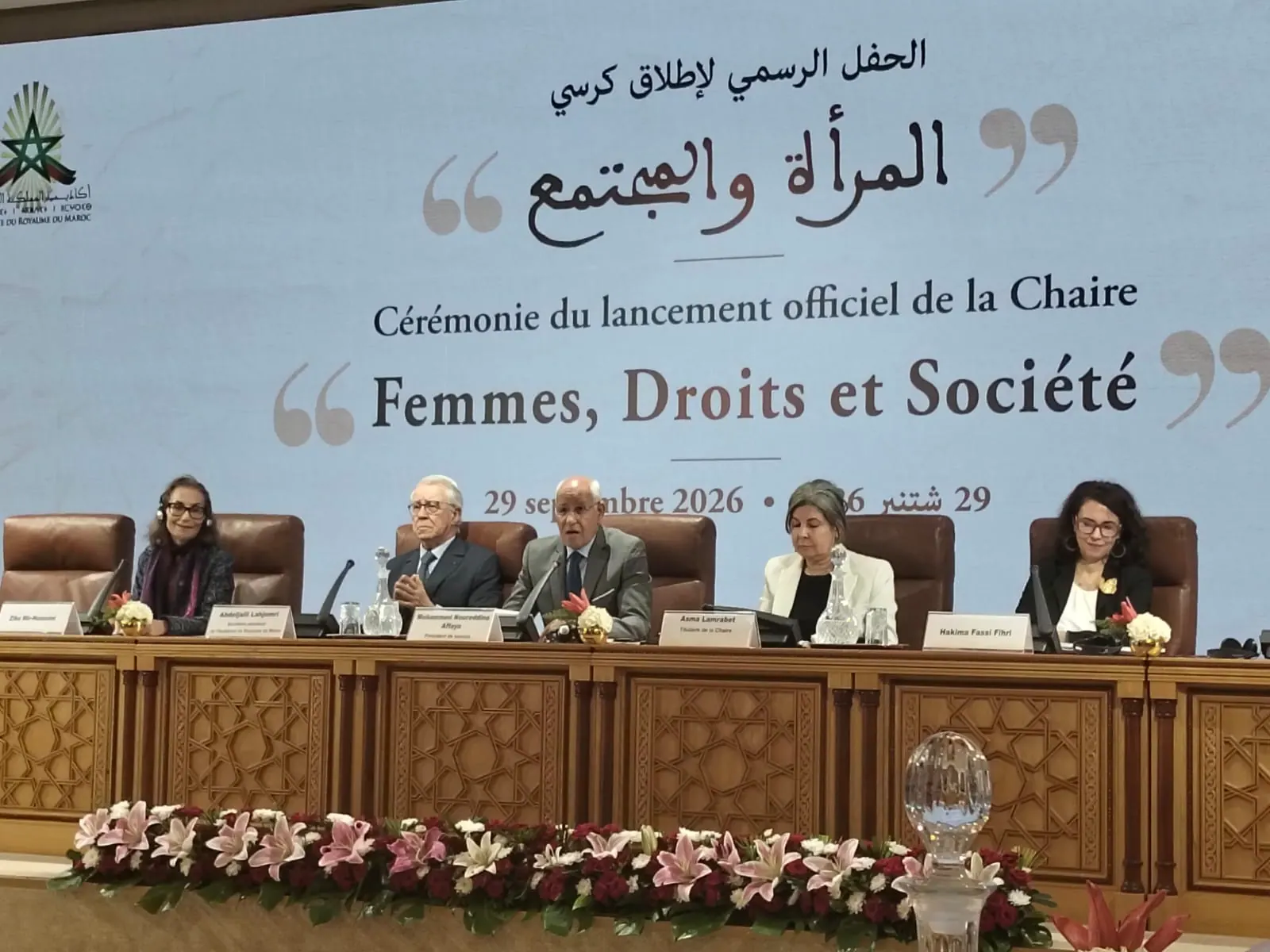
The Royal Academy of Morocco has officially launched the "Women, Rights, and Society" (FDS) chair, overseen by Dr. Asmaa Merabite, a permanent member of the academy. In her inaugural speech, Merabite expressed gratitude to the academy's permanent secretary, emphasizing that this initiative aligns with Morocco's major social and political trends in women's rights and family issues. She noted that Morocco is at a critical juncture, ahead of the new Family Code reform, which is part of a continuous dynamic of comprehensive and peaceful modernization.
Merabite recalled that Morocco's 2004 and 2007 reforms, including the Family Code and Nationality Code, as well as the 2011 Constitution, which enshrined equality, have constituted a genuine social, legal, and cultural revolution. She highlighted that these reforms were made possible by the long struggles of Moroccan women between 1970 and 1990 and the high political will of King Mohammed VI. Merabite emphasized that Morocco has become a reference model in the Arab-Islamic region, and the dynamic of reforms needs to be consolidated and accelerated to address remaining challenges.
Despite significant progress, Merabite noted that some areas still require completion, including the legal framework, combating stereotypes, reducing economic disparities, preventing violence, and promoting women's political representation. The holder of the "Women, Rights, and Society" chair aims to transform the constitutional momentum into a shared culture of equality by encouraging dialogue between references and promoting a moral, humanistic, and enlightened reading of Morocco's cultural heritage.
Merabite called for transcending the dichotomy between the universal reference to human rights and the cultural and religious reference. The "Women, Rights, and Society" chair proposes an academic space for excellence, multidisciplinary and transdisciplinary, covering humanities, law, social sciences, and theology. Its specificity lies in its connection to the local context and its adoption of a humanistic and ethical approach to Islam, open to the international level.
The chair's mission is to rethink the changes affecting the family, produce concrete and practical knowledge based on the Moroccan reality, and promote a common ethics of justice based on equality, which is the foundation of Moroccan constitutional philosophy. Merabite concluded her speech by citing King Mohammed VI's speech in 2022: "When women have their full rights, they do not harm men... and the condition for Morocco to continue its progress is that women take their rightful place."
The ultimate goal of the chair is to contribute to achieving fair, sustainable, and harmonious societal development for all. The initiative is part of Morocco's efforts to promote women's rights and equality. The launch of the chair demonstrates Morocco's commitment to advancing women's rights and promoting a culture of equality.
The "Women, Rights, and Society" chair is expected to play a significant role in promoting women's rights and empowerment in Morocco. The initiative has been welcomed by various stakeholders, who see it as a positive step towards achieving gender equality in the country. The chair's activities will focus on research, education, and awareness-raising to promote women's rights and empowerment.
Key points
- The Royal Academy of Morocco launches "Women, Rights, and Society" chair to promote equality and enhance women's rights.
- The chair aims to transform the constitutional momentum into a shared culture of equality.
- The initiative is part of Morocco's efforts to promote women's rights and equality.