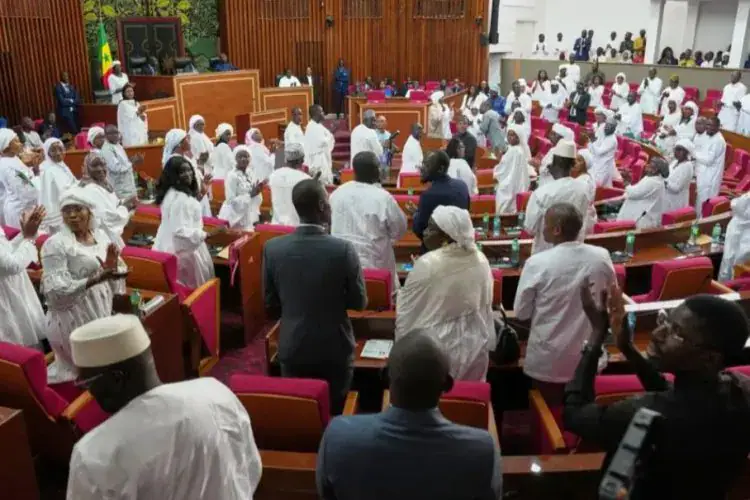
The Senegalese parliament has begun reviewing a revised 2026 budget proposal, with the ruling party, Pastef, expressing concerns over proposed cuts to healthcare and education funding. The government aims to secure approval for the revised budget to ensure it can pay off debts owed to businesses and move forward with a $2.2 billion loan package from the International Monetary Fund (IMF). The review process started on a Tuesday morning, following unsuccessful negotiations between the government and Pastef.
The revised budget plan involves reducing revenue by 340 billion CFA francs and increasing fuel subsidies from 250 billion to 790 billion CFA francs due to rising oil prices. To offset these changes, the government plans to cut investment spending by 555 billion CFA francs and allocate 300 billion CFA francs to pay off debts owed to businesses. Pastef, which holds 130 out of 165 seats in parliament, has refused to support the revised budget in its current form.
Pastef is demanding the implementation of laws regulating the state's special funds. On October 26, the party's deputies sent letters to the Ministry of Finance requesting renewed negotiations. However, according to Depite Amadou Ba, the party's spokesperson, they have not received a response. The Prime Minister has stated that he is open to finding a mutually agreeable solution.
If Pastef continues to oppose the revised budget, the current budget will remain in effect, and no additional funds will be allocated for fuel subsidies or debt repayment. This could hinder the implementation of an IMF loan package worth $2.2 billion. The government may invoke Article 86 of the Constitution to pass the revised budget without a vote, unless parliament votes on a no-confidence motion within 24 hours.
The disagreement over the budget has significant implications for Senegal's economic policy and its relationship with the IMF. The government is under pressure to secure funding to address its debt obligations and stabilize the economy. The IMF loan package is seen as crucial to supporting Senegal's economic recovery.
The review of the revised budget is taking place against a backdrop of rising oil prices and increasing economic challenges. The government's efforts to adjust the budget and secure IMF funding are aimed at mitigating these challenges and promoting economic growth.
The outcome of the budget review will have far-reaching consequences for Senegal's economic policy and its ability to address pressing social and economic issues. The government's ability to negotiate a compromise with Pastef and secure IMF funding will be crucial in determining the country's economic trajectory.
Key points
- The Senegalese parliament is reviewing a revised 2026 budget proposal amid disagreements between the ruling party and opposition on allocations for healthcare and education.
- The government aims to secure approval for the revised budget to ensure it can pay off debts owed to businesses and move forward with a $2.2 billion loan package from the IMF.
- The disagreement over the budget has significant implications for Senegal's economic policy and its relationship with the IMF.