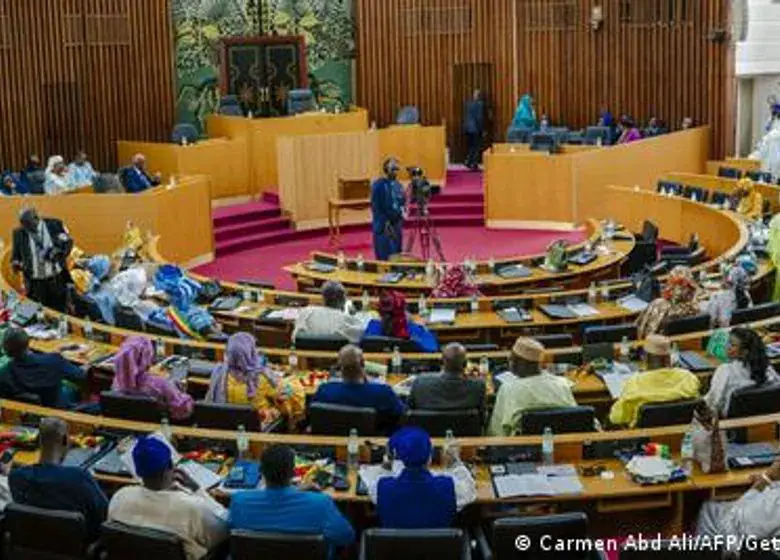
The Senegalese government's revised budget has been rejected by parliament for the third time, amid disagreements over revenue, public spending, and economic priorities. The rejection is a significant setback for President Bassirou Diomaye Faye and his government. The vote, which took place on November 2, 2026, saw 109 lawmakers vote in favor of a preliminary question presented by Amadou Ba, a member of the Pastef party, 20 against, and three abstentions.
The Pastef party, led by Ousmane Sonko, has a comfortable majority of 130 seats in the 165-member parliament. The party's disagreement with the government's budget revisions reflects deeper divisions within the ruling coalition. According to Seneweb, the parliamentarians rejected the budget revisions without examining the details, citing concerns over the credibility of the government's financial forecasts.
One of the key areas of contention is the evaluation of the budget deficit, which the government announced at 7.6% of GDP. The Pastef party disputes this figure and questions the accuracy of the government's financial data. The party also opposes measures aimed at reducing the deficit, including a reduction of 555 billion FCFA in investment spending and a decrease in subsidies for petroleum products.
The government's budget revisions had proposed several austerity measures to restore public finances. However, these measures have been met with resistance from lawmakers, who are keen to protect the purchasing power of households and maintain investments in education, vocational training, and social sectors. The minister of economy and finance, Cheikh Diba, has denounced the opposition's stance as a pretext for rejecting the government's budget.
The rejection of the budget revisions has immediate consequences for the state's finances. The government had counted on the revised budget to honor debts to private companies, pay electricity suppliers, and maintain the supply of fuel to power plants. The rejection also jeopardizes the prospects of securing a $2.2 billion financing facility from the International Monetary Fund.
The IMF is awaiting guarantees on Senegal's budget trajectory as the country seeks to control its deficit and restore confidence in its public financial management. The government's failure to secure a compromise with its parliamentary majority means that it must revisit its budget work. The outcome will depend on its ability to present a credible budget that balances the need for fiscal discipline with the social priorities defended by lawmakers.
The rejection of the budget revisions highlights the challenges facing the Faye government in navigating the complex landscape of Senegalese politics. The government's ability to find common ground with its parliamentary majority will be crucial in determining the country's economic trajectory. The next steps will be closely watched by investors, international creditors, and the Senegalese public.
Key points
- The Senegalese parliament has rejected the government's revised budget for the third time, citing disagreements over revenue, public spending, and economic priorities.
- The rejection jeopardizes the prospects of securing a $2.2 billion financing facility from the International Monetary Fund.
- The government's failure to secure a compromise with its parliamentary majority means that it must revisit its budget work.