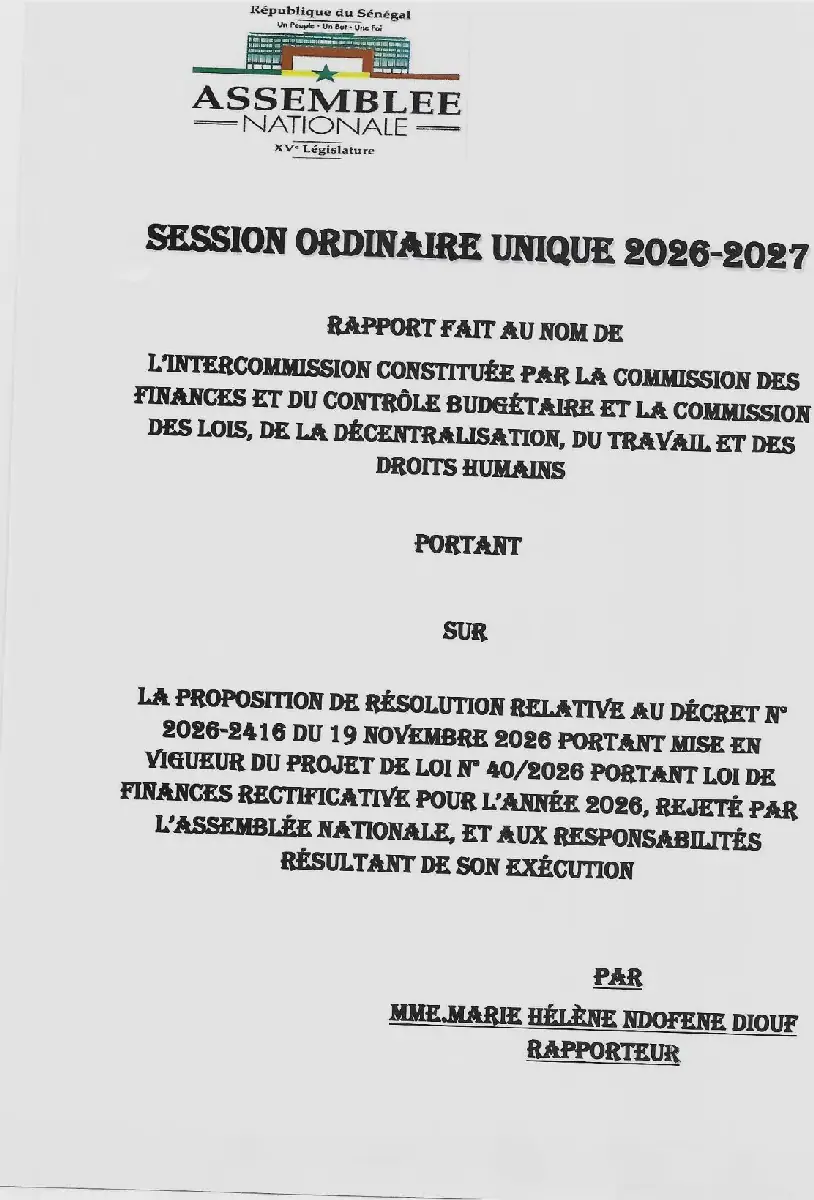
The Senegalese National Assembly's intercommission, comprising the Finance and Budget Control Commission and the Laws, Decentralization, Labor, and Human Rights Commission, convened on November 24, 2026, to examine a proposal for a resolution on the 2026 supplementary budget. The meeting followed the publication of Decree No. 2026-2416 on November 19, 2026. The intercommission reviewed the constitutionality of the decree and its implications on the Assembly's budgetary powers.
The intercommission's discussions centered on the application of Article 68 of the Constitution, which relates to the adoption of budgetary laws. There was debate on the distinction between the absence of a vote and the definitive rejection of a bill. The commission also examined alternative mechanisms for budget management and the country's international financial commitments. Mohamed Ayib Salim Daffé, author of the proposal on behalf of the PASTEF - Les Patriotes parliamentary group, addressed the commission.
A key aspect of the discussions was the legal scope of the resolution and its implications for the continuity of the 2026 budget. The intercommission sought to clarify the non-binding nature of the resolution and its political, institutional, and symbolic value. Additionally, the roles and responsibilities of public officials in the budgetary process were scrutinized, including those of budget administrators, controllers, public accountants, and tax and customs administrations.
The intercommission adopted three amendments to the proposal, focusing on international financial commitments, regular monitoring of budget execution, and the National Assembly's availability to examine finance bills. These amendments aimed to enhance transparency and accountability in budget management. The adopted resolution also underscored the importance of maintaining budget continuity and ensuring that the 2026 supplementary budget aligns with the country's financial obligations.
The intercommission's report, presented on November 25, 2026, detailed the debates and decisions made during the meeting. The report highlighted the main points of discussion, including the constitutionality of the decree, the interpretation of Article 68 of the Constitution, and the preservation of the National Assembly's budgetary prerogatives. The report also included responses from Mohamed Ayib Salim Daffé and other commission members.
The adoption of the proposal and amendments by the intercommission marks a significant step in the examination of the 2026 supplementary budget. The National Assembly's Finance and Budget Control Commission had previously reviewed the initial budget proposal in October 2026. The Assembly will continue to scrutinize the supplementary budget, ensuring that it aligns with the country's financial needs and obligations.
The examination of the 2026 supplementary budget proposal reflects the National Assembly's commitment to ensuring transparency and accountability in budget management. The intercommission's work highlights the importance of collaboration between different parliamentary commissions in addressing complex budgetary issues. The adopted resolution and amendments will inform the finalization of the 2026 supplementary budget, which is crucial for Senegal's economic and social development.
Key points
- The Senegalese National Assembly's intercommission adopted a proposal for a resolution on the 2026 supplementary budget, focusing on its constitutionality, budgetary implications, and international financial commitments.