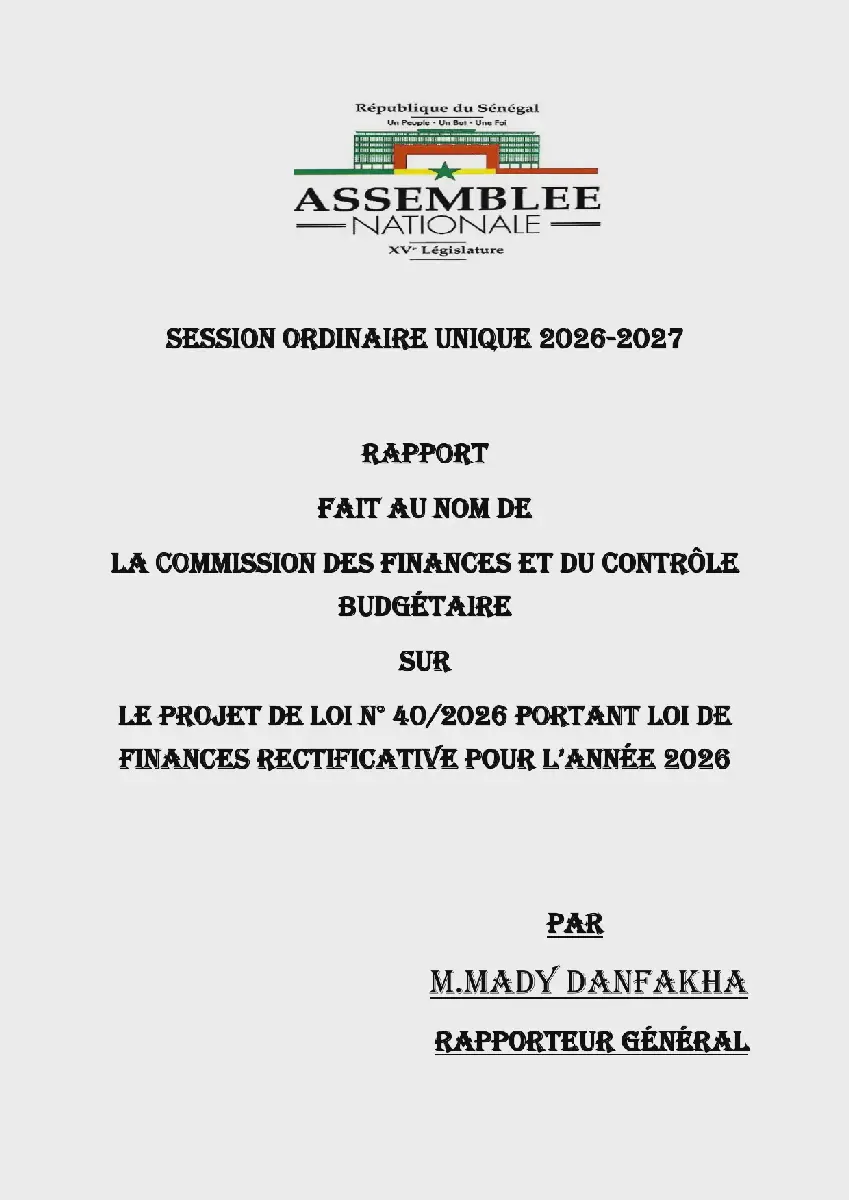
The Senegalese National Assembly's Commission des Finances et du Contrôle budgétaire met on October 30, 2026, to re-examine the draft bill n° 40/2026 on the 2026 supplementary finance law. The commission rejected the bill, along with two government-proposed amendments, over concerns about the budget adjustments, energy subsidies, and transparency. The commission's 57-page report outlines the discussions between lawmakers and ministers on the proposed budget revisions.
The projected budget deficit for 2026 stands at 1,735.2 billion FCFA, accounting for 7.6% of the country's GDP. Several commission members questioned the accuracy of this figure, citing concerns about the budget's sincerity. The energy sector is set to receive 790.3 billion FCFA in subsidies to mitigate rising costs. The commission also raised questions about the reduction of certain public investment credits, including 295.6 billion FCFA linked to expected revenue from the Plan de redressement économique et social (PRES).
The commission's report highlights concerns about Senegal's debt and outstanding arrears. A total of 1,956.3 billion FCFA in arrears remains to be addressed after payments made in 2025. Lawmakers requested additional documentation, including audit reports and details on debt, financing, and expenditure execution. Despite receiving supplementary explanations from the government, commission members maintained their concerns about transparency and accountability.
The Commission des Finances et du Contrôle budgétaire's decision to reject the bill has significant implications for Senegal's economic policy. The proposed budget revisions aimed to adjust to changing economic conditions and address pressing social needs. However, the commission's concerns about the budget's accuracy and transparency have stalled the process. The bill is now set to be examined in a plenary session on November 3, 2026.
The rejection of the budget revision bill has sparked debate about Senegal's economic management. Some argue that the proposed adjustments were necessary to address the country's economic challenges, while others support the commission's concerns about transparency and accountability. The National Assembly's decision will have far-reaching consequences for Senegal's economic trajectory and its ability to address pressing social needs.
The Commission des Finances et du Contrôle budgétaire's report provides a detailed analysis of the proposed budget revisions. The document outlines the commission's concerns about the budget's accuracy, energy subsidies, and public investment credits. It also highlights the need for greater transparency and accountability in Senegal's economic management. The report is available online, offering valuable insights into the country's economic policy debates.
The fate of the 2026 budget revision bill remains uncertain. The National Assembly's plenary session on November 3, 2026, will determine the bill's future. If passed, the revised budget will have significant implications for Senegal's economic policy and its ability to address pressing social needs. If rejected, the government may need to revisit its economic plans and engage in further negotiations with lawmakers.
Key points
- The Senegalese National Assembly's Commission des Finances et du Contrôle budgétaire rejected the 2026 budget revision bill over concerns about deficit, energy subsidies, and transparency.