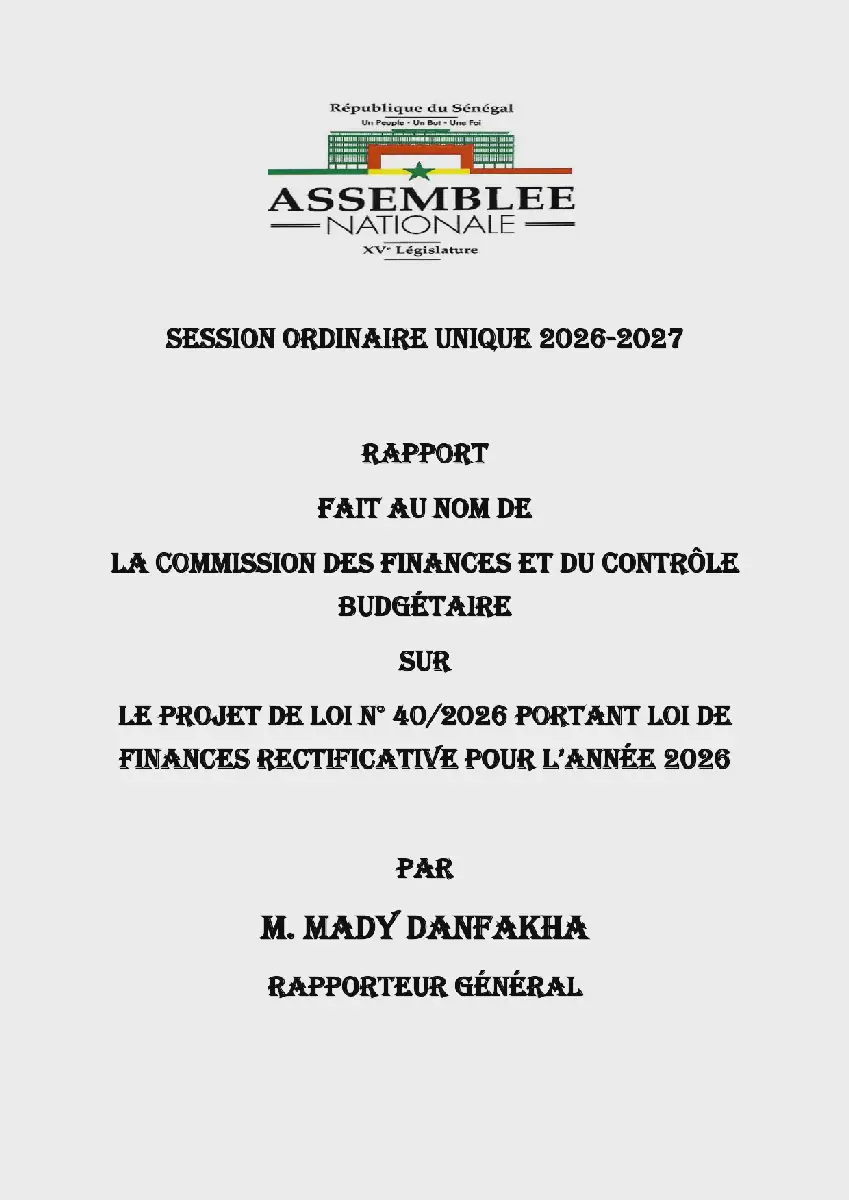
The Commission des Finances et du Contrôle budgétaire of Senegal's National Assembly has examined the draft supplementary budget bill for 2026, presented by the government on October 20 and 23, 2026. The bill outlines adjustments to the budget, including reduced revenues, increased energy subsidies, and revised public investments, in response to external and internal economic shocks. The Commission rejected the bill, pending clarifications on debt, social investments, and funding transparency.
The supplementary budget bill, numbered 40/2026, forecasts a 5.5% decline in total revenues, from 6,188.8 to 5,848.7 billion FCFA, and a 2% increase in expenditures, from 7,433.9 to 7,583.9 billion FCFA. This would widen the budget deficit to 1,735.2 billion FCFA, equivalent to 7.6% of GDP. Energy subsidies are expected to surge by 540.3 billion FCFA to 790.3 billion FCFA, or 3.5% of GDP, to cushion the impact of rising oil prices.
The economic recovery plan, known as the Plan de redressement économique et social (PRES), has been revised downward, with expected revenues of 311.5 billion FCFA, significantly lower than the initial 762.9 billion FCFA projection. This reduction has led to a freeze on investment projects. In response, the government has introduced five new tax measures, including a solidarity economic contribution on businesses' turnover, with a rate of 8-10%, and a minimum lump-sum tax set at 0.5% of turnover.
Social spending remains a priority, with an allocation of 2,276 billion FCFA, accounting for 30% of total expenditures. The health sector will see an increase of 28.8 billion FCFA, while family social security allowances will double from 35 to 70 billion FCFA. The Commission has emphasized the need for greater transparency in funding and has requested additional information on debt and social investments.
The finance commission's review of the supplementary budget bill took place against a backdrop of economic challenges, including external shocks and domestic pressures. The Commission's concerns about debt, social investments, and funding transparency reflect the need for careful management of public finances in a volatile economic environment.
The Senate's finance commission report on the 2026 supplementary budget bill provides insights into the government's budgetary priorities and the challenges facing the country's economy. The report's recommendations and the government's response will be crucial in shaping the country's economic policy and ensuring fiscal sustainability.
The 2026 supplementary budget bill is part of a broader effort to address economic challenges and promote sustainable growth in Senegal. The government's budgetary adjustments and policy measures will be closely watched by stakeholders, including investors, civil society, and the international community.
Key points
- The supplementary budget bill forecasts a 5.5% decline in total revenues and a 2% increase in expenditures.
- Energy subsidies are expected to surge by 540.3 billion FCFA to 790.3 billion FCFA.
- Social spending remains a priority, with an allocation of 2,276 billion FCFA.