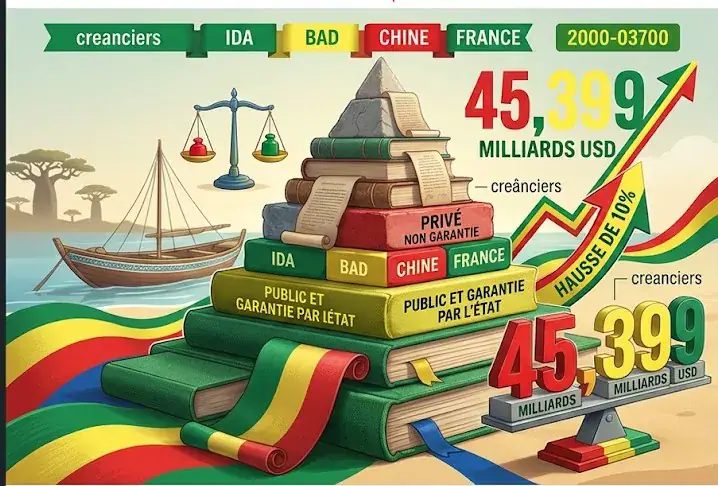
The total external debt of Senegal has reached $45.399 billion in 2025, equivalent to over 26,531 billion CFA francs. This represents a 10% increase compared to 2024. According to the International Debt Report 2026 by the World Bank Group, released on November 5, 2026, Senegal's external debt has more than quadrupled since 2015, when it stood at $10.47 billion.
The structure of Senegal's external debt by debtor shows that public and state-guaranteed debt accounts for $29.589 billion, approximately 65% of the total. Private non-guaranteed debt stands at $13.101 billion, around 29%, while short-term debt is estimated at $2.709 billion, or 6% of the global amount. Notably, the weight of private non-guaranteed debt is significant, as it does not benefit from state guarantees but affects the country's overall external position.
According to the World Bank, the breakdown of public and guaranteed debt by type of creditor reveals three categories. Multilateral creditors are owed approximately $13.287 billion, or 45%. Private and bilateral creditors are owed $11.108 billion and $5.193 billion, respectively. The World Bank, through the International Development Association (IDA), is the leading multilateral creditor with $5.186 billion, followed by the African Development Bank (AfDB) with $2.135 billion.
Bilateral creditors have also been identified, with China being the leading creditor at $2.086 billion, followed by France at $1.611 billion, and other bilateral creditors who have lent $1.497 billion to the Senegalese state. The report also notes that nearly 38% of public debt is due to private creditors, exposing the country to market conditions that are generally more costly than concessional financing.
The service of Senegal's debt has seen significant fluctuations over the decade, with a marked peak followed by a sharp decline in 2025. However, the level remains above the interquartile range of 25-75% of reporting countries. This situation places Senegal among the most indebted countries in the sample. The terms of new engagements in 2025 show that official creditors have an average maturity of 13 years, a four-year amortization deferral, and an interest rate of 3.0%.
The increase in Senegal's external debt raises concerns about the country's financial sustainability. The government may need to implement measures to manage its debt and ensure that it does not become a significant burden on the economy. The World Bank report highlights the need for careful management of external debt to avoid potential risks and ensure sustainable economic growth.
The Senegalese government will need to balance its need for financing with the need to manage its debt effectively. This may involve negotiations with creditors, implementing fiscal reforms, and exploring alternative financing options. The country's economic growth and development prospects will depend on its ability to manage its external debt effectively and maintain a stable financial situation.
Key points
- Senegal's external debt has reached $45.399 billion in 2025, a 10% increase from 2024.