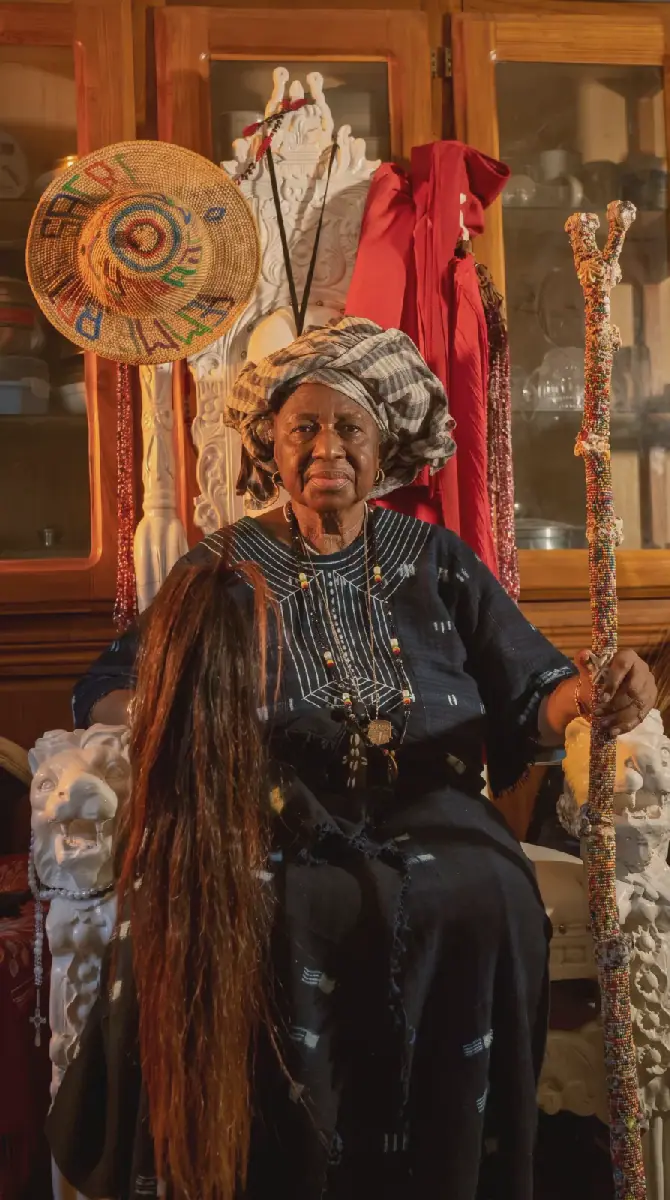
Marie Rosalie Coly, known as Apoye Étame, a priestess of the sacred forests in Casamance, Senegal, is seeking institutional recognition for her role in preserving traditional knowledge and protecting the environment. She aims to highlight the importance of traditional practices and their contribution to cultural heritage, environmental conservation, and social cohesion. Apoye Étame's efforts focus on promoting dialogue between traditional institutions and public authorities.
Apoye Étame's initiative emphasizes the significance of recognizing traditional knowledge and its transmission. She stresses that this recognition does not seek to establish a parallel authority or political power but rather to acknowledge the existing cultural and community responsibilities within traditional settings. According to Pape Cheikh Ahab Ndiaye, the public relations officer for the Queen Mother, the goal is to facilitate dialogue between public institutions and women who carry inherited memories and practices.
The sacred forests, considered spaces of memory, spirituality, and transmission, are central to Apoye Étame's advocacy. These areas are seen as reservoirs of knowledge about nature, plants, life cycles, social rules, and community-environment relationships. Ndiaye highlights the fragility of this heritage, citing the loss of knowledge holders, disrupted intergenerational transmission, and environmental degradation, which can lead to the irretrievable loss of practices and knowledge.
To address these concerns, the proposed program includes a participatory inventory, intergenerational transmission mechanisms, and measures to protect sensitive sites and knowledge. The initiative suggests involving women guardians of sacred forests, customary authorities, local governments, researchers, and youth organizations in its implementation. This approach aims to value traditional knowledge without detaching it from its holders or transforming it into tourist commodities.
Apoye Étame's role in community mediation and conflict prevention is also emphasized. In a region marked by decades of conflict, traditional dialogue and reconciliation mechanisms are seen as valuable resources for peacebuilding. The advocacy argues that women's traditional experience should inform peace education programs, solidarity initiatives, intergenerational dialogue, and public policies for social cohesion.
To translate these ambitions into concrete measures, several proposals are submitted to competent authorities. One suggestion is to consider recognizing Apoye Étame as a "Living Human Treasure," acknowledging her transmission of traditional knowledge and practices. This status would be strictly consultative, providing a platform for her expertise in projects related to heritage, environment, and social cohesion.
The initiative also proposes establishing a Consultative Council of Queens of Casamance, bringing together representatives from traditional spaces in Ziguinchor, Sédhiou, and Kolda. This platform would facilitate dialogue with public authorities, formulate proposals on heritage preservation, and enhance women's participation in local decision-making. A charter would outline principles of respect for the Republic, solidarity, dialogue, and protection of heritage and transmission to younger generations.
Key points
- Apoye Étame seeks recognition for her role in preserving traditional knowledge and protecting sacred forests in Casamance, Senegal.
- The initiative proposes establishing a Consultative Council of Queens of Casamance to facilitate dialogue and cooperation between traditional institutions and public authorities.
- The recognition of traditional knowledge and practices is seen as essential for cultural heritage, environmental conservation, and social cohesion in Senegal.