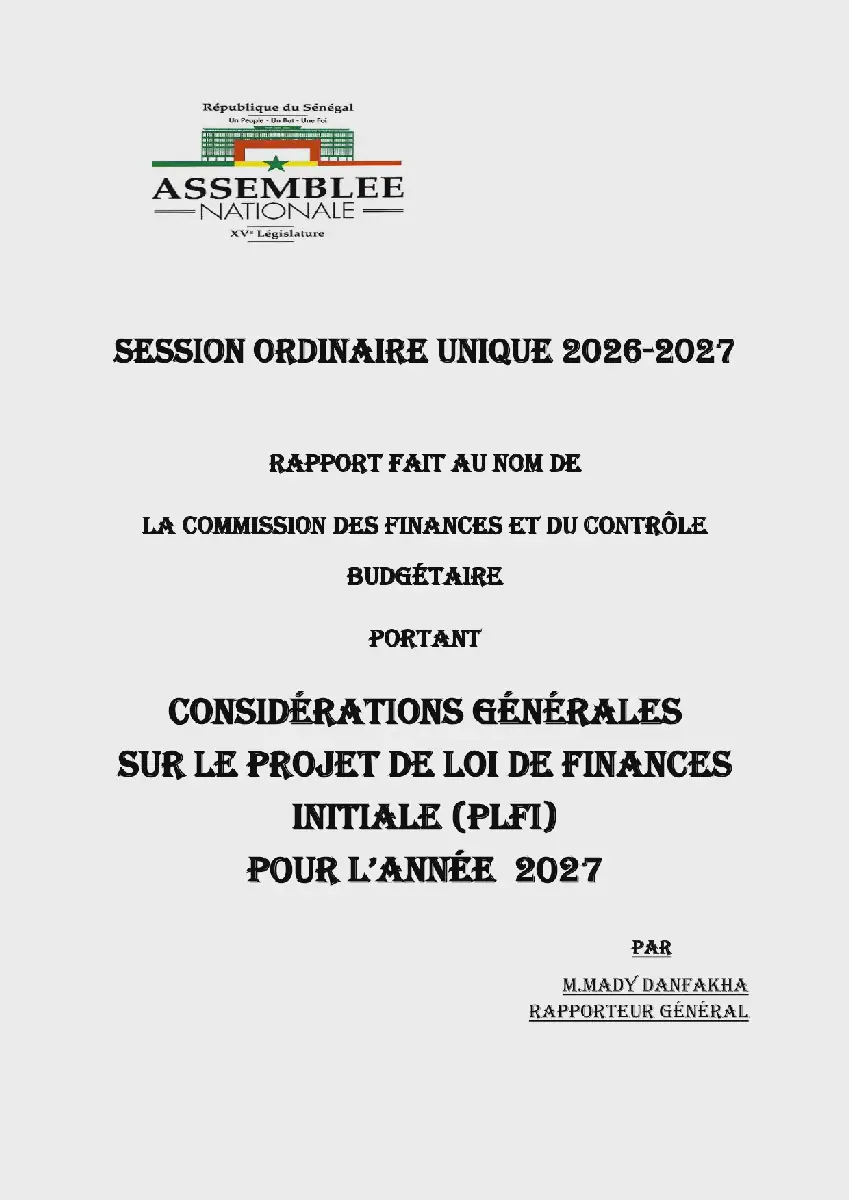
The Senegalese National Assembly's Finance Commission presented a report on November 7, 2026, examining the initial 2027 finance bill. The report analyzes budget priorities, tax reforms, debt management, and sectoral allocations. The commission, led by the Minister of Economy, Finance, and Planning, discussed and recommended changes to the bill. The report highlights concerns over revenue projections, debt management, and public spending allocations.
The 2027 finance bill projects revenues of 5,653.9 billion FCFA and expenditures of 7,005.6 billion FCFA, resulting in a deficit of 1,351.7 billion FCFA, or 4.7% of GDP. The commission, however, rejected the revenue projections, debt management provisions, and budget allocations for public authorities for 2027. This decision follows responses from ministers and reflects concerns over the country's financial management.
Senegal has secured a technical agreement with the International Monetary Fund (IMF) on September 1, 2026, paving the way for a three-year program worth $2.2 billion, or 1,243 billion FCFA, for 2026-2029. This agreement aims to support Senegal's economic development and stabilize its finances. The program will likely influence the country's budget planning and financial reforms.
The 2027 budget plan allocates 140 billion FCFA for family social security grants, targeting 1,000,649 vulnerable households. This represents an increase in funding for social protection programs. Additionally, the plan includes investments in healthcare infrastructure, with five major hospitals scheduled for 2027, backed by 416 billion FCFA in commitment authorizations.
The budget plan also establishes a restructuring fund for struggling enterprises, capitalized with 22 billion FCFA, operating as a special treasury account. This move aims to support businesses facing difficulties and promote economic resilience. The fund's creation reflects the government's efforts to address economic challenges and foster growth.
The Finance Commission's report and recommendations will inform the National Assembly's decision on the 2027 finance bill. The assembly's approval or rejection of the bill will have significant implications for Senegal's economic management and budget implementation. The government's ability to address the commission's concerns will be crucial in determining the bill's fate.
The 2027 budget plan is part of a broader effort to promote economic development and improve living standards in Senegal. The government's priorities, as outlined in the plan, focus on social protection, healthcare, and economic growth. The implementation of the plan will be closely monitored, and its success will depend on effective financial management and coordination among government agencies.
Key points
- The Senegalese National Assembly's Finance Commission rejected key aspects of the 2027 finance bill, citing concerns over revenue projections, debt management, and public spending allocations.