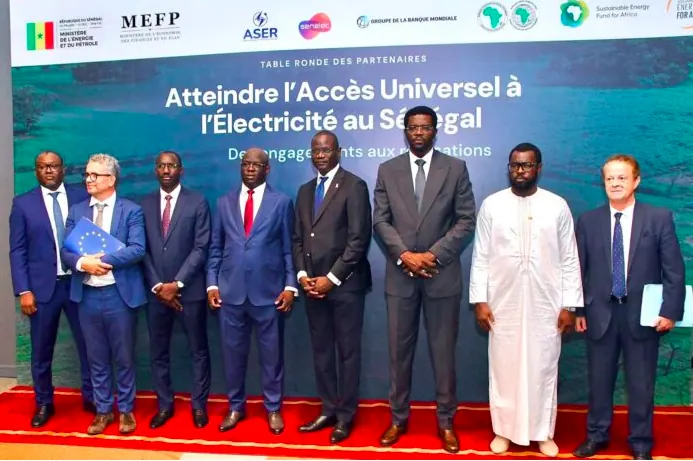
The Senegalese government has made a significant stride towards achieving universal electricity access by 2029. On October 6, 2026, a roundtable discussion was held with international financial partners and private investors, resulting in a commitment of 998 billion FCFA, exceeding initial expectations. This major financial mobilization aims to support the country's energy strategy and social equity goals. The meeting was co-chaired by Minister of Energy, Oil, and Mines, Dr. El Hadji Abdourahmane Diouf, and Minister of Economy, Finance, and Planning, Cheikh Diba.
According to the Ministry of Energy, Senegal's current national access rate stands at 86.2% as of the end of 2024. Out of 25,725 localities recorded in Senegal, 12,683 are already electrified, and 6,571 are under construction as part of ongoing projects. However, 6,471 isolated localities remain to be connected, affecting approximately one million Senegalese citizens without access to electricity. Initially, the financial needs for this last phase were estimated at 400 billion FCFA.
The response from financial partners and investors during the roundtable exceeded government expectations. Technical and financial partners (PTF) pledged 181 billion FCFA to finance new network extension projects and renewable energy initiatives. The private sector contributed a substantial 817 billion FCFA, accompanied by several complementary offers submitted online. This significant mobilization of funds is expected to have a positive impact on social and economic development.
For Dr. El Hadji Abdourahmane Diouf, this record fundraising effort must translate into immediate social and economic impact. Universal access to electricity is seen as a fundamental driver for reducing disparities between urban and rural areas, stimulating local industrialization, and creating jobs for young people. The main challenge now lies in project maturity, the speed of market procedures, and the actual implementation of projects on the ground by 2029.
The Senegalese government's goal is to ensure that the entire national territory has access to electricity by 2029. To achieve this, the authorities will focus on the effective implementation of projects, taking into account the challenges of the last kilometer, which involves connecting isolated localities. The involvement of both public and private sectors will be crucial in achieving this ambitious objective.
The Ministry of Energy, Oil, and Mines, along with other stakeholders, will oversee the implementation of projects and monitor progress. Ensuring transparency and efficient management of funds will be essential in achieving the set goals. The government aims to create a sustainable and equitable energy system that benefits all segments of society.
Senegal's efforts to achieve universal electricity access by 2029 demonstrate its commitment to sustainable development and social equity. With a substantial investment of 1,000 billion FCFA, the country is poised to make significant progress in reducing energy disparities and promoting economic growth. The success of this initiative will depend on effective project implementation and collaboration between all stakeholders.
Key points
- Senegal aims to achieve universal electricity access by 2029 with a 1,000 billion FCFA investment.
- The country currently has an 86.2% national access rate, with 6,471 isolated localities remaining to be connected.
- The investment will be used to support the country's energy strategy and social equity goals.