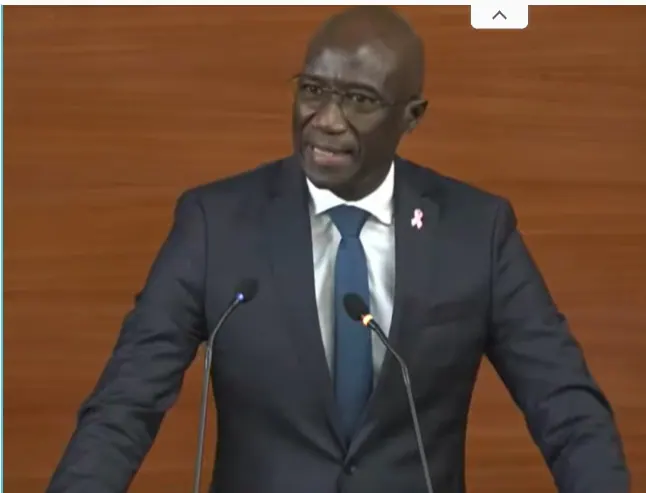
The Senegalese government has activated a blocked vote on an organic law related to special funds. On October 1, 2026, the Minister of Justice, Me Moussa Sarr, invoked Article 82 of the Constitution and Article 87 of the National Assembly's internal regulations. He requested a single vote on the bill, limited to two government amendments. This move has sparked a lively debate in parliament.
Me Moussa Sarr justified the government's position, stating that the blocked vote is a constitutional prerogative of the government. The goal is to preserve the bill's architecture and ensure its coherence. The minister emphasized that this mechanism aims to prevent the fragmentation or distortion of the text through divergent parliamentary amendments. This would guarantee the effectiveness of public action and ensure a global harmony on the framework for special funds.
The blocked vote is seen as an instrument of rationalization of parliamentarism. Me Moussa Sarr stressed that it is up to the government to assess the opportunity to engage this mechanism to promote the general interest. The government's position has been met with 181 reads and 2 comments so far. The article was published by Harouna Fall, editor of Télé Futurs Médias.
The organic law on special funds has been a subject of discussion in Senegal. The government's decision to activate the blocked vote has significant implications for the country's legislative process. This move may impact the balance of power between the executive and legislative branches.
The Senegalese parliament is currently examining the proposal for an organic law on special funds. The government's request for a blocked vote has raised questions about the level of debate and scrutiny. The outcome of this process will likely have far-reaching consequences for the country's governance and financial management.
Me Moussa Sarr's invocation of Article 82 of the Constitution has sparked controversy. Some argue that this move restricts the ability of parliamentarians to propose amendments. Others see it as a necessary measure to ensure the coherence and effectiveness of the bill.
The blocked vote on the organic law for special funds is a significant development in Senegal's politics. The government's decision has sparked a lively debate about the role of parliament and the balance of power between the executive and legislative branches. The outcome of this process will be closely watched by stakeholders and observers.
Key points
- The Senegalese government has activated a blocked vote on an organic law related to special funds, sparking a lively debate in parliament.
- The blocked vote is seen as an instrument of rationalization of parliamentarism, aimed at preserving the bill's architecture and ensuring its coherence.
- The government's decision has significant implications for the country's legislative process and the balance of power between the executive and legislative branches.