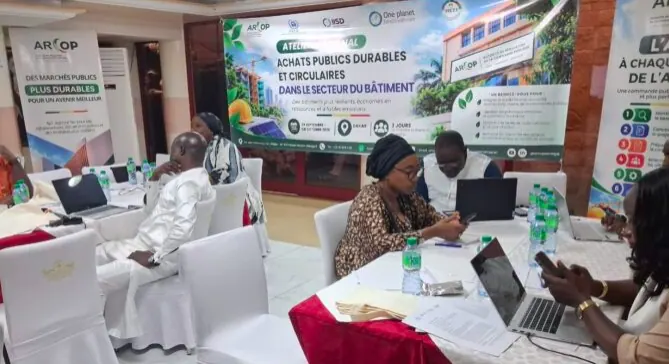
The Senegalese government has initiated a strategic shift in managing public funds, focusing on sustainable procurement. From September 29 to October 1, 2026, the Autorité de Régulation de la Commande Publique (ARCOP) and the United Nations Environment Programme (UNEP) convened stakeholders in Dakar to incorporate environmental and circular criteria into public procurement. This move aligns with Senegal's "Sénégal 2050" plan.
The public procurement market in Senegal is substantial, with the state and its agencies mobilizing approximately 3,000 billion FCFA annually. The current approach prioritizes the lowest price, but the new strategy aims to adopt a life-cycle cost approach, considering factors like maintenance, energy consumption, and deconstruction. This change is expected to drive sustainable practices and reduce the environmental impact of public spending.
The construction sector, which accounts for 7% of Senegal's GDP and 76.3% of public market value between 2017 and 2021, will be a key focus area for the reform. The sector's significant environmental impact and projected 200% increase in electricity consumption by 2030 make it a priority for sustainable development. The ARCOP is working to revise standard consultation documents to include binding environmental clauses and encourage the private sector to develop eco-friendly products.
The workshop concluded with the development of a national action plan for sustainable public procurement and the establishment of a steering committee to oversee the implementation of these reforms. The committee will ensure the gradual expansion of sustainable procurement requirements to cover not only construction but also goods and services.
According to ARCOP Director General Dr. Moustapha Djitté, the goal is to move away from the short-term cost approach and adopt a more comprehensive life-cycle perspective. This shift will enable Senegal to leverage its significant public procurement budget to drive sustainable development and reduce its environmental footprint.
The reform is part of Senegal's broader strategy to achieve its climate and environmental goals, as outlined in the "Sénégal 2050" plan. By integrating environmental and circular criteria into public procurement, the government aims to promote sustainable practices, reduce greenhouse gas emissions, and protect the country's natural resources.
The successful implementation of this reform will depend on collaboration between the public and private sectors, as well as civil society. With the support of international organizations like the UNEP, Senegal is poised to make significant strides in sustainable development and environmental protection.
Key points
- The Senegalese government has set a goal to leverage its 3,000 billion FCFA public procurement budget to drive sustainable development and reduce its environmental footprint.