The European Union has approved tougher migration rules in a bid to tighten its borders. The new rules, approved by EU ministers in Luxembourg, aim to enable more effective returns of people with no legal right to stay in the EU. The rules allow member states to impose a broader range of penalties on people who fail to follow the order to leave and authorise special measures for those who are deemed to pose a security risk.
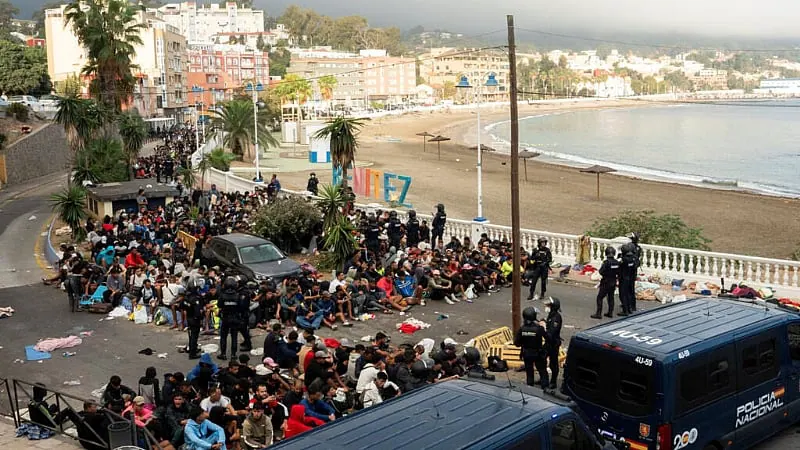
The talks in Luxembourg were the first in-person meeting of EU ministers since the summer's migrant rush to Ceuta tested European border security. In late July, 70,000 migrants crossed over from Morocco, triggering a diplomatic spat between Spain and Italy. The influx led to calls for the EU to take a harder line on migration. The new rules are part of the EU's efforts to overhaul its migration and asylum process.
The revised return rules adopted by the EU Council will allow member states to implement swift returns effectively. According to Ireland's Minister for Justice, Home Affairs and Migration, Jim O'Callaghan, around two in three people ordered to leave the EU do not actually leave. The new rules will assist member states in implementing returns effectively and deliver a common approach to migration management under the Pact on Migration and Asylum.
The Pact on Migration and Asylum, enforced since June, hardened EU border procedures and overhauled the asylum process. However, critics such as Human Rights Watch say the pact makes it easier for EU countries to detain asylum-seekers and rush decisions on their claims. The pact also set out an emergency response in the event of unexpected surges in migration, allowing governments to reduce protections for asylum-seekers.
EU ministers also heard proposals to step up surveillance of online platforms as part of a European Commission plan to prevent sudden, large-scale arrivals. The plan would see EU border agency Frontex given more powers to monitor social media. Croatia's interior minister, Davor Bozinovic, suggested that monitoring social media could help prevent sudden arrivals.
The EU has also agreed on a legal framework for the establishment of return hubs, which would serve as reception centres in countries outside the EU for adult migrants who cannot safely return to their country of origin. Proponents say return hubs could facilitate repatriations and act as a deterrent for would-be irregular migrants. However, critics question their effectiveness, citing hurdles faced by similar projects.
Several EU countries, including Denmark, Austria, Greece, Germany, and the Netherlands, are exploring options to set up return hubs in third countries. Greek migration minister Thanos Plevris said his country is aiming to open a centre in 2027 in an African country. The new migration rules are due to come into force within weeks, marking a significant shift in the EU's approach to migration management.
Key points
- The EU has approved tougher migration rules to enable more effective returns of people with no legal right to stay in the EU.
- The new rules are part of the EU's efforts to overhaul its migration and asylum process, following a surge in migrants to Ceuta in July.
- The EU is also exploring options to set up return hubs in third countries to facilitate repatriations and act as a deterrent for would-be irregular migrants.