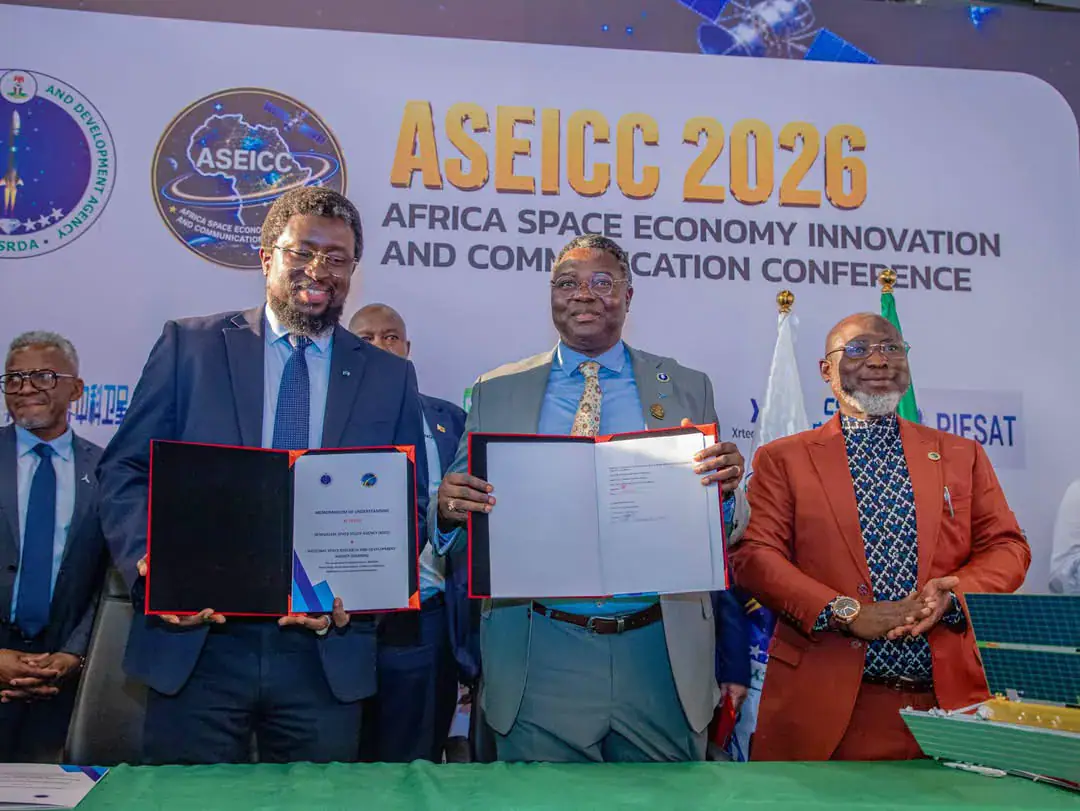
The Senegalese Agency for Space Studies (ASES) and the Nigerian National Space Research and Development Agency (NASRDA) signed a memorandum of understanding on November 25, 2026, in Abuja, Nigeria. The agreement aims to develop the scientific, technological, and industrial capacities of both countries. The partnership focuses on promoting competence transfer, innovation, and African technological sovereignty.
The agreement was signed by Maram Kairé, Director-General of ASES, and his Nigerian counterpart, Professor Matthew Olumide Adepoju. This partnership establishes a framework for cooperation between the two institutions. The signing of this protocol follows the first exchanges between the leaders of the two agencies, held in September 2026 in Abidjan, Côte d'Ivoire, during the Africa Space Expo (ASPEX 2026).
The cooperation will cover several strategic sectors of the space industry, including the design, development, and integration of satellites, Earth observation, remote sensing, and the exploitation of geospatial data. The two agencies also plan to develop initiatives in artificial intelligence, spatial data analysis, and satellite operations. Additionally, the partnership will focus on scientific research, training programs, internships, and personnel exchanges.
The agreement prioritizes education and the dissemination of space sciences and technologies to young generations. By pooling their expertise and infrastructure, Senegal and Nigeria aim to strengthen their respective capacities. This partnership is part of a broader dynamic of developing the African space economy. Both countries recognize the importance of mastering satellite technologies and geospatial data for sovereignty, security, and economic development.
The partnership aligns with the orientations of the African Union's Space Policy and Strategy and the dynamic promoted by the African Space Agency. For ASES, this cooperation represents a new step in implementing its strategy for developing national space capacities and diversifying international partnerships. The agreement reflects Senegal's commitment to prioritizing South-South cooperation and strengthening scientific and technological relations with other African countries.
Maram Kairé emphasized the need for the continent to develop its own scientific, technological, industrial, and financial capacities. He stressed the importance of making Africa an actor capable of designing, developing, and mastering its own space technologies, rather than remaining solely a market for solutions produced elsewhere. This partnership contributes to building African expertise in a sector that still relies heavily on foreign technologies.
The cooperation between Senegal and Nigeria marks a significant step towards enhancing Africa's presence in the global space industry. The two countries aim to leverage their combined strengths to drive innovation and technological advancements in the space sector. This strategic partnership has the potential to yield long-term benefits for both nations and the broader African region.
Key points
- The partnership aims to promote competence transfer, innovation, and African technological sovereignty.
- The agreement covers several strategic sectors, including satellite development, Earth observation, and artificial intelligence.
- The partnership aligns with the African Union's Space Policy and Strategy and the dynamic promoted by the African Space Agency.