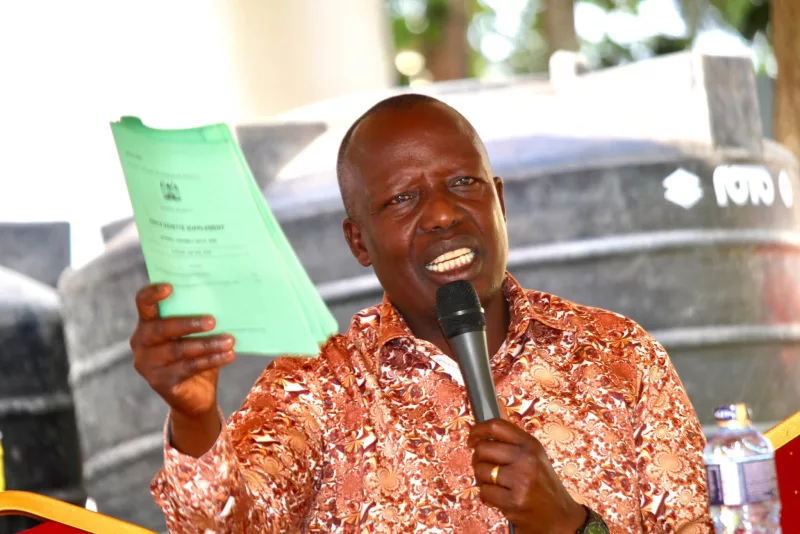
The Seventh-day Adventist Church has asked Parliament to amend the proposed Basic Education Bill, 2026, to give it representation on County Education Boards in areas where it is a majority sponsor of schools. The proposal was among submissions made during public participation forums on the six education reform Bills held in Nyamira, Tharaka-Nithi and Migori counties. The church argued that the proposed composition of County Education Boards does not adequately recognise faith-based sponsors with a significant presence in particular regions.
The church wants Section 32(1)(e), (f) and (g) of the Bill amended to allow representation based on the level of institutional presence of faith-based sponsors. Pastor Enock Ooga told the National Assembly Departmental Committee on Education that the church proposes to retain the rendering as it was in the 2013 Education Act to include the option of any other majority faith-based institution that could be having more institutional presence in that region. The Bill provides for a representative of the National Council of Churches in Kenya and Evangelical Fellowship of Kenya, a representative of the Kenya Episcopal Conference and a representative of the Muslims Education Council.
The Adventist Church wants the provision changed to allow three persons representing majority-based sponsors, where applicable, instead of reserving representation for the named religious bodies alone. This would mean a faith-based organisation could secure representation on a County Education Board in counties where it has a dominant role in sponsoring schools. The proposed change aims to ensure that faith-based sponsors with a significant presence in particular regions have a voice in the management of education.
In Migori, calls for a split in the management of public primary and junior schools dominated discussions, with concerns over the definition of comprehensive education in the proposed Basic Education Bill. The Kenya Union of Post-Primary Education Teachers (Kuppet) described the management model as unclear and called for the structure to be spelt out more clearly in law. The union wants public primary, junior and senior schools to operate as distinct levels, each with its own leadership and clearly defined administrative responsibilities.
Kuppet has consistently argued that junior school has distinct curriculum requirements, specialised teachers, national assessments and learning needs that require a management structure suited to the level. The union has consequently pushed for junior school to have greater autonomy, with clear leadership and accountability, rather than being absorbed into a comprehensive school structure. This approach would help reduce administrative conflicts and ensure that each level receives attention and resources appropriate to its mandate and needs.
Currently, junior schools are domiciled in primary schools as a matter of policy, as proposed by the Presidential Working Group on Education Reform. The proposed Basic Education Bill seeks to give the comprehensive-school model a legal basis, under which different levels of basic education would operate within a common management structure. Kuppet has opposed this approach, while the Kenya National Union of Teachers (KNUT) has backed the comprehensive-school model.
The issue generated controversy and emerged as one of the most contested proposals during the nationwide public participation exercise. The Education Committee chairperson, Julius Melly, told stakeholders that their submissions would form part of the legislative process and urged them to continue sending memoranda before the exercise closed. The committee will conclude the nationwide public participation exercise with hearings in Bomet and Samburu, completing the additional phase covering 16 counties.
Key points
- The Seventh-day Adventist Church wants representation on County Education Boards in areas where it is a majority sponsor of schools.
- Kuppet wants public primary, junior and senior schools to operate as distinct levels, each with its own leadership and clearly defined administrative responsibilities.
- The proposed Basic Education Bill, 2026, aims to reform basic education management, national assessment, teacher training, qualifications and curriculum development.