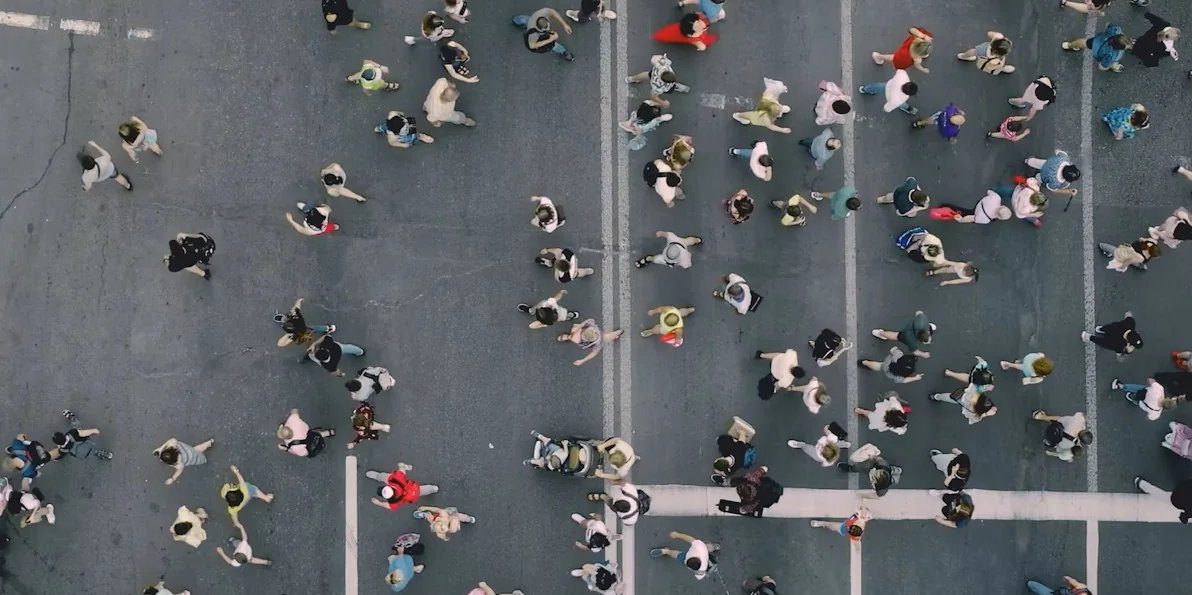
Researchers in Kenya have made an intriguing discovery about human behavior, finding that individuals and crowds tend to turn left when walking. The study, which began in 2020 during the COVID-19 lockdown, observed that participants repeatedly walked in loops that turned anticlockwise. This phenomenon, described as emergent behavior, was not consciously perceived by the participants. The team's findings have sparked interest in understanding the underlying reasons for this behavior.
Initial hypotheses focused on the role of handedness and wall interactions in influencing the direction of rotation. Researchers tested whether right-handed participants turned left while left-handers turned right, but experiments with sorted volunteers showed that the anticlockwise bias persisted regardless of handedness or wall proximity. This led the team to explore alternative explanations for the observed behavior.
To further investigate, the researchers moved their experiment outdoors to a 3,000-square-meter school playground, eliminating walls entirely. Surprisingly, the leftward rotation not only survived but intensified, ruling out the enclosure as the cause. The team also explored a cultural explanation based on traffic-side conventions, comparing Spanish-driving crowds, which dodge right, with a Japanese group that typically steps left.
The study found that both groups still rotated anticlockwise, disproving the cultural-driving hypothesis. Even nursery-school children, who have minimal exposure to adult conventions, displayed the strongest leftward tendency, suggesting that the bias is not learned. This finding has significant implications for understanding human behavior and its development.
To determine whether the bias exists at the individual level or emerges from crowd interactions, the researchers had over 200 volunteers walk alone in an empty arena. A clear majority still moved anticlockwise, indicating that the bias exists at the individual level. This individual-level data was then fed into a computational model, which reproduced the full-crowd swirl.
The study's authors acknowledge that the underlying cause of the leftward preference is still unknown. However, recognizing the individual origin of the bias could inform the design of public spaces such as airports and museums. The researchers' findings have the potential to contribute to the development of more efficient and effective public spaces.
The five-year study's results provide valuable insights into human behavior and its underlying mechanisms. Further research is needed to uncover the reasons behind the observed leftward bias, but the current findings offer a fascinating glimpse into the complexities of human behavior. The study's authors are optimistic that continued investigation will shed more light on this intriguing phenomenon.
Key points
- The study found that individuals and crowds tend to rotate anticlockwise, but the underlying cause of this behavior remains unclear.
- The leftward bias persists regardless of handedness, wall proximity, or cultural background.
- Recognizing the individual origin of the bias could inform the design of public spaces such as airports and museums.